Cells & molecules
Meiosis
Cell biology · Cell division
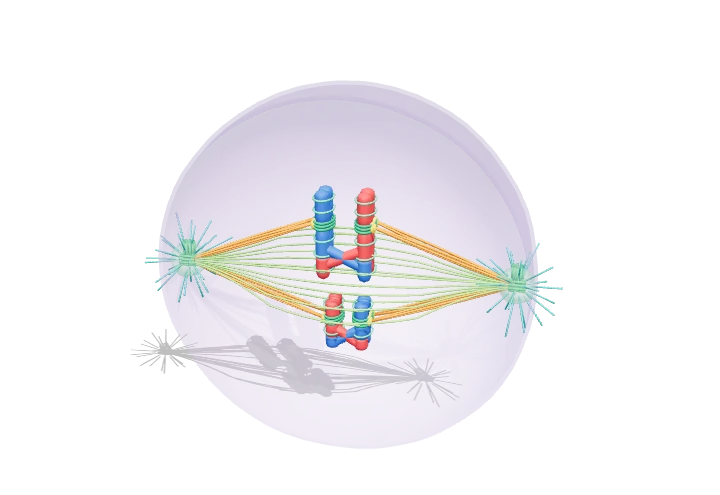 Open the interactive 3D model →
Why do brothers and sisters with the same two parents never turn out identical?
You got one set of chromosomes from your mother and one from your father. To make eggs or sperm, a cell divides twice, shuffling and swapping pieces of those two sets so every egg or sperm gets just one set — and a different mix each time. This special division is called meiosis.
Meiosis is the pair of divisions that turns one diploid germ cell into four haploid cells, halving the chromosome number for sexual reproduction. In meiosis I homologous chromosomes pair, recombine and separate; in meiosis II, without further DNA replication, sister chromatids separate.
Key facts
- Divisions
- 2 (meiosis I reductional, meiosis II equational) after one S phase
- Products
- 4 haploid cells (sperm); 1 egg + 2–3 polar bodies in oogenesis
- Human chromosome number
- 2n = 46 → n = 23
- Crossovers in humans
- ≈ 2–3 per bivalent; ≈ 50–70 per meiosis
- Assortment combinations (humans)
- 2²³ ≈ 8.4 million per parent, before crossing over
- Duration
- Human male ≈ 3–4 weeks; female prophase I arrest lasts 12–50 years
Parts you can explore (11)
- Plasma membrane
- Nuclear envelope
- Paternal chromosomes
- Maternal chromosomes
- Kinetochores
- Cohesin
- Synaptonemal complex
- Chiasmata
- Centrosomes
- Spindle microtubules
- Contractile ring
In the 3D model
Rotate and take apart the model, follow a guided tour of what each part does and why it’s needed, change it with a live slider, and test yourself with a short quiz. Free, no sign-up.
OpenArc Models’ models are simplified teaching schematics. Terms · Privacy