Mechanisms
Mechanical watch movement
Mechanisms · Horology
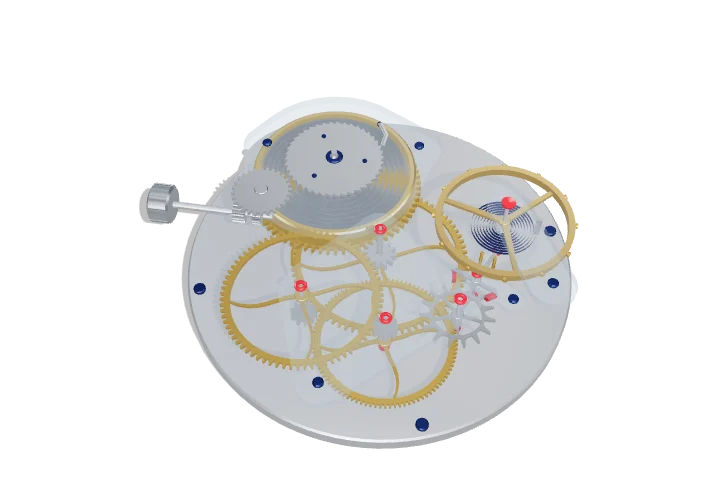 Open the interactive 3D model →
How does a wound-up spring keep time to within a few seconds a day, with no battery at all?
Winding a mechanical watch coils up a spring, which then tries to spin a chain of gears. A tiny wheel with its own hair-thin spring swings back and forth exactly four times a second, and a rocking lever lets the gears move on by just a little at each swing — that is the tick. The swinging wheel keeps the same beat whether it swings wide or narrow, so the hands move at a steady pace.
A mechanical watch stores energy in a coiled mainspring and releases it through a gear train whose speed is governed by a balance wheel and hairspring — a torsional oscillator — via the Swiss lever escapement. Each beat the escapement unlocks the train for an instant, lets the escape wheel advance half a tooth and gives the balance a small push, so the oscillator’s nearly amplitude-independent period sets the rate of the hands.
Key facts
- Beat rate (model)
- 28 800 vibrations per hour = 8 beats/s = 4 Hz
- Escape wheel
- 15 teeth; 12° (½ tooth) per beat → 16 rev/min
- Train (representative)
- barrel 72/12 → centre 80/10 → third 75/10 → fourth 96/6 → escape
- Lift angle
- ≈ 50° of balance rotation in contact with the fork (model: 50°)
- Healthy amplitude
- ≈ 270–310° fully wound; below ≈ 200° indicates trouble
- Power consumption
- of order 1 µW
Parts you can explore (14)
- Mainspring barrel
- Centre wheel
- Third wheel
- Fourth wheel
- Escape wheel
- Pallet fork
- Balance wheel
- Hairspring
- Keyless works
- Main plate
- Bridges
- Jewel bearings
- Dial
- Motion work and hands
In the 3D model
Rotate and take apart the model, follow a guided tour of what each part does and why it’s needed, change it with a live slider, and test yourself with a short quiz. Free, no sign-up.
Open Mechanical watch movement in 3D →
OpenArc Models’ models are simplified teaching schematics. Terms · Privacy