Mechanisms
Stepped-drum calculator
Mechanisms · Computing
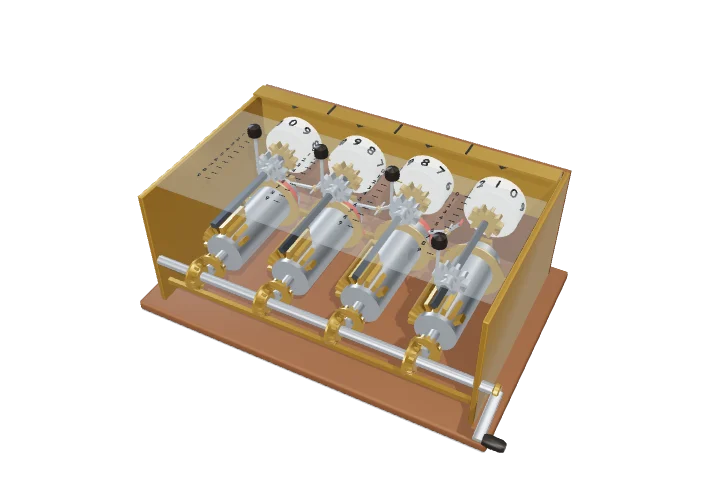 Open the interactive 3D model →
How could a box of gears do arithmetic 300 years before electronic calculators?
This calculator stores a number on wheels marked 0 to 9, like a car’s mileage counter. You set a digit with a knob and turn a crank once, and a cleverly stepped drum turns the counting wheel on by exactly that many places. When a wheel rolls over from 9 to 0, a little tooth adds one to the next wheel — the “carry one” you learned at school.
A stepped-drum calculator stores a number on counting wheels and adds a set number to it with each turn of a crank: in every column a Leibniz wheel — a drum with nine teeth of graded length — turns a sliding pinion by as many tenths of a revolution as the digit set. When a counting wheel passes from 9 to 0, a carry mechanism adds one to the next column, and staggering the carries round the drums lets them ripple through all the columns within a single turn.
Key facts
- Invented
- Gottfried Wilhelm Leibniz, stepped reckoner, 1672–1694
- Teeth per drum
- 9, of lengths 1 to 9 steps
- Advance per turn
- d tenths of a revolution for a setting d
- Model
- 4 columns, register starts at 0985, units digit set by the slider
- Carry order
- carry teeth at 200°, 230°, 260° → ripple units → thousands in one turn
- Commercial use
- Thomas arithmometer, sold from 1851
Parts you can explore (10)
- Base and frame
- Crank and main shaft
- Stepped drums
- Sliding pinions
- Square shafts
- Setting knobs
- Counting wheels
- Result register
- Carry teeth
- Carry levers
In the 3D model
Rotate and take apart the model, follow a guided tour of what each part does and why it’s needed, change it with a live slider, and test yourself with a short quiz. Free, no sign-up.
Open Stepped-drum calculator in 3D →
OpenArc Models’ models are simplified teaching schematics. Terms · Privacy