Chemistry
Mass spectrometer (magnetic sector)
Analytical chemistry · Instrumentation
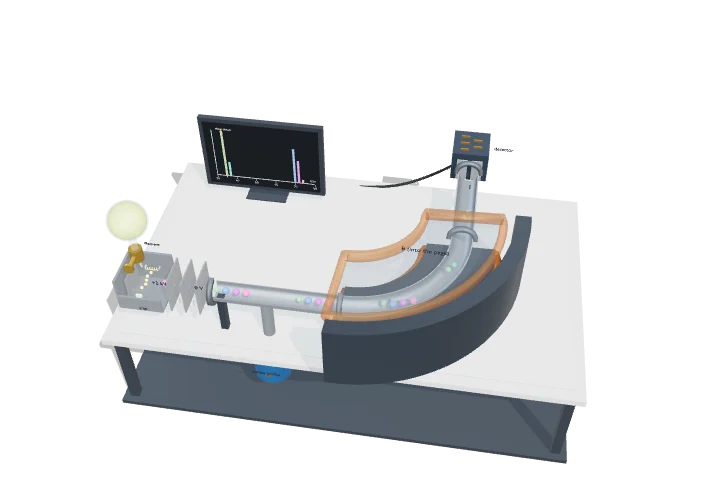 Open the interactive 3D model →
How can you weigh a single atom — and tell two kinds of chlorine apart by a difference of two neutrons?
A mass spectrometer turns molecules into charged particles (ions), fires them down a tube, and bends their paths with a magnet. Heavier ions are harder to turn, so they swing round wider curves. By changing the magnet’s strength, the machine lets one mass at a time hit a detector and counts how many arrive.
A mass spectrometer turns molecules into gas-phase ions, accelerates them and separates them by mass-to-charge ratio, here by bending their paths in a magnetic field. Scanning the field brings each m/z in turn onto a detector, producing a spectrum that reveals isotopes, molecular masses and fragmentation patterns.
Key facts
- Ionisation energy (EI)
- 70 eV electrons
- Accelerating voltage (model)
- 2.00 kV
- Sector radius (model)
- 20.0 cm
- Operating pressure
- ≈ 10⁻⁴–10⁻⁶ Pa
- ³⁵Cl : ³⁷Cl natural abundance
- 75.8% : 24.2% (≈ 3 : 1)
- Field for m/z 35 (model)
- 0.190 T
Parts you can explore (11)
- Sample inlet
- Ion source
- Electron beam
- Accelerating plates
- Flight tube
- Electromagnet
- Ion beams
- Detector
- Vacuum pumps
- Spectrum display
- Chassis
In the 3D model
Rotate and take apart the model, follow a guided tour of what each part does and why it’s needed, change it with a live slider, and test yourself with a short quiz. Free, no sign-up.
Open Mass spectrometer (magnetic sector) in 3D →
OpenArc Models’ models are simplified teaching schematics. Terms · Privacy