Astronomy & space
Mars rover (Perseverance-like)
Planetary exploration · Rover
 Open the interactive 3D model →
How do you drive a car-sized robot over rocks on a planet so far away that each command takes minutes to arrive?
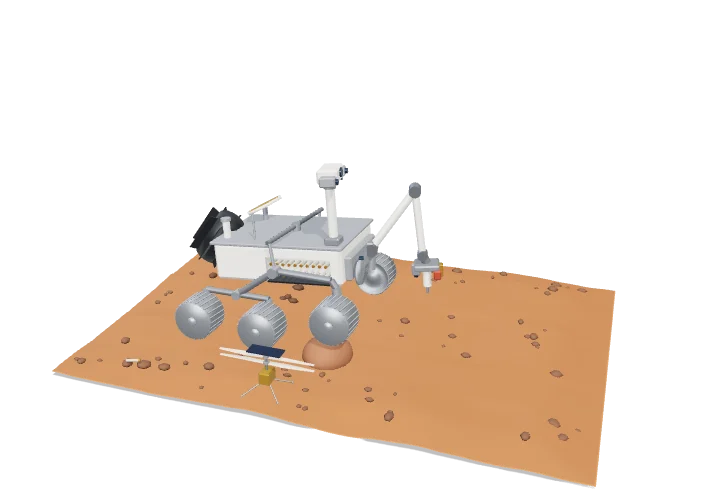
Perseverance is a six-wheeled robot geologist exploring an ancient dried-up lake on Mars. Its clever suspension keeps all six wheels on the ground as it climbs rocks, and its arm drills out finger-sized rock cores that may hold signs of ancient life.
Perseverance is a 1,025 kg nuclear-powered rover that landed in Jezero Crater on 18 February 2021 to search for signs of ancient microbial life and to collect rock cores for eventual return to Earth. Its six-wheeled rocker-bogie suspension, instrument mast, robotic arm with coring drill and sample-caching system make it a mobile field geologist.
Key facts
- Mass
- 1,025 kg (rover); Ingenuity 1.8 kg
- Size
- ≈ 3.0 m long × 2.7 m wide × 2.2 m tall
- Wheels
- 6 × 52.5 cm diameter, aluminium with titanium spokes
- Power
- MMRTG, ≈ 110 W electrical at launch
- Top speed
- ≈ 0.15 km/h (4.2 cm/s) on flat ground
- Sample tubes
- 43 (38 for samples, 5 witness tubes)
Parts you can explore (10)
- Chassis (body)
- Rocker-bogie suspension
- Wheels
- Remote sensing mast
- Robotic arm and turret
- MMRTG power source
- Sample tubes
- Antennas
- Ingenuity helicopter
- Martian terrain and rock
In the 3D model
Rotate and take apart the model, follow a guided tour of what each part does and why it’s needed, change it with a live slider, and test yourself with a short quiz. Free, no sign-up.
Open Mars rover (Perseverance-like) in 3D →
OpenArc Models’ models are simplified teaching schematics. Terms · Privacy