Astronomy & space
Mars
Planetary science · Terrestrial planet
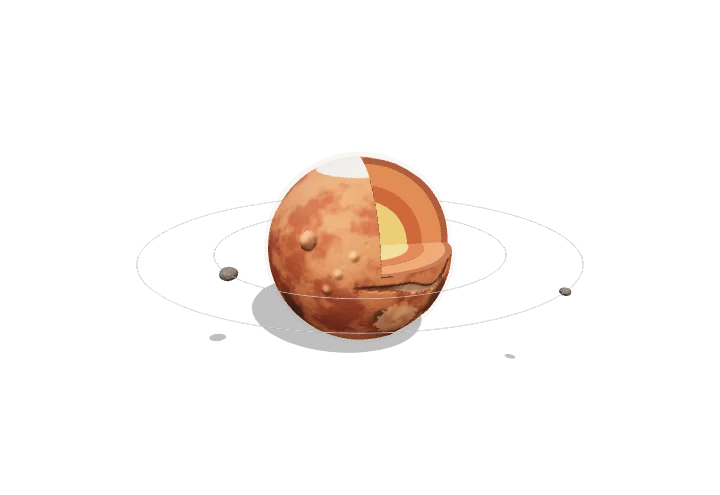 Open the interactive 3D model →
How did a planet half the size of Earth end up with a volcano nearly three times taller than Everest?
Mars is a cold, rocky planet about half as wide as Earth. Its red colour comes from rusty dust, and its air is so thin that liquid water cannot last on the surface today. It has the biggest volcano and one of the longest canyons in the Solar System, polar ice caps that grow and shrink with the seasons, and two tiny moons.
Mars is a small, cold terrestrial planet whose single-plate lithosphere let volcanoes such as Olympus Mons grow to record heights and whose crust split to form Valles Marineris. Its thin CO₂ atmosphere exchanges mass with seasonal polar caps, and seismic data from InSight show a thin crust above a large liquid iron core.
Key facts
- Mean radius
- 3,389.5 km (0.53 Earth)
- Surface gravity
- 3.72 m s⁻² (0.38 g)
- Day / year
- Sol 24 h 39.6 min / 687 Earth days
- Obliquity
- 25.2°
- Surface pressure
- ≈ 6 mbar mean (95 % CO₂)
- Mean surface temperature
- ≈ −60 °C (≈ 210 K)
Parts you can explore (12)
- Surface and crust
- Olympus Mons
- Tharsis Montes
- Valles Marineris
- Polar ice caps
- Mantle
- Core
- Atmosphere
- Dust storm
- Phobos
- Deimos
- Moon orbits
In the 3D model
Rotate and take apart the model, follow a guided tour of what each part does and why it’s needed, change it with a live slider, and test yourself with a short quiz. Free, no sign-up.
OpenArc Models’ models are simplified teaching schematics. Terms · Privacy