Mechanisms
5-speed manual gearbox
Mechanisms · Automotive drivetrain
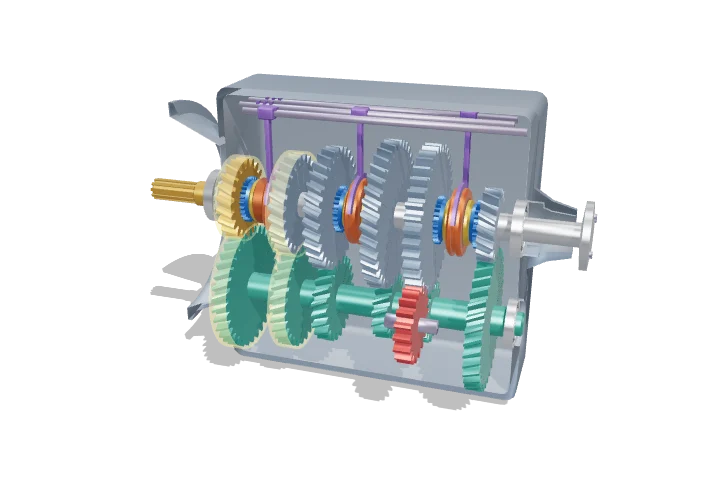 Open the interactive 3D model →
Why does a car need five different gears — and what really moves when you change gear?
An engine works best in a narrow range of speeds, but a car must crawl up hills and cruise on motorways. A gearbox lets the engine turn the wheels slowly with lots of force, or quickly with less. Surprisingly, the gears never slide in and out of mesh: they all spin all the time, and a sliding collar locks just one of them to the output shaft.
A constant-mesh manual gearbox keeps every gear pair permanently in mesh and selects a ratio by locking one free-running gear to the output shaft with a sliding, synchronised dog clutch. The ratio is the product of the constant-mesh reduction to the countershaft and the reduction of the selected pair, except in direct drive where input and output are locked together.
Key facts
- Ratios in this model
- 1st 3.82, 2nd 2.32, 3rd 1.47, 4th 1.00, 5th 0.78, R 4.07
- Constant-mesh reduction
- 33/20 = 1.65
- Typical passenger-car 1st gear
- ≈ 3.3–4.2 : 1
- Mesh efficiency per gear pair
- ≈ 98–99 %
- Helix angle (forward gears)
- ≈ 20–30° typical; 22° here
- Synchroniser cone angle
- ≈ 6–7° typical
Parts you can explore (11)
- Input shaft
- Countershaft
- Output shaft
- Mainshaft gears
- Reverse idler
- Dog teeth
- Synchronisers
- Shift forks
- Bearings
- Power path
- Gearbox casing
In the 3D model
Rotate and take apart the model, follow a guided tour of what each part does and why it’s needed, change it with a live slider, and test yourself with a short quiz. Free, no sign-up.
Open 5-speed manual gearbox in 3D →
OpenArc Models’ models are simplified teaching schematics. Terms · Privacy