Human body
Male reproductive system
Anatomy · Reproductive system
 Open the interactive 3D model →
Why does a sperm cell travel through about 7 metres of coiled tubing before it leaves the body?
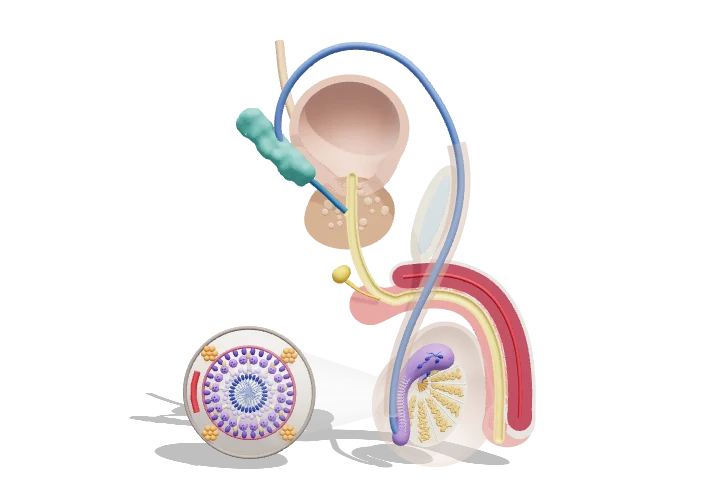
The male reproductive system makes sperm, the cells that carry half of a baby’s genes, and the hormone testosterone. Sperm are made in the testes, mature in a coiled tube called the epididymis, then travel up a long duct, the vas deferens. Glands along the way add fluid to make semen, which leaves through the urethra.
The testes produce sperm in the seminiferous tubules and testosterone in the interstitial Leydig cells, under the control of FSH and LH from the anterior pituitary. A duct system — epididymis, vas deferens, ejaculatory duct and urethra — matures, stores and delivers sperm, while the seminal vesicles, prostate and bulbourethral glands add the fluid that makes up most of the semen.
Key facts
- Testis size
- ≈ 4–5 × 2.5 × 3 cm; ≈ 15–25 mL volume
- Spermatogenesis
- ≈ 64–74 days from spermatogonium to spermatozoon
- Sperm production
- ≈ 100–200 million per day (both testes)
- Epididymal duct length
- ≈ 6 m, coiled into ≈ 5 cm
- Male urethra
- ≈ 18–20 cm (prostatic ≈ 3–4, membranous ≈ 1–2, spongy ≈ 15 cm)
- Semen volume
- ≈ 2–5 mL per ejaculate
Parts you can explore (16)
- Testis
- Seminiferous tubule (inset)
- Leydig cells
- Epididymis
- Vas deferens
- Seminal vesicle
- Ejaculatory duct
- Prostate
- Bulbourethral gland
- Urethra
- Urinary bladder
- Corpora cavernosa
- Corpus spongiosum & glans
- Scrotum
- Pubic symphysis
- Sperm
In the 3D model
Rotate and take apart the model, follow a guided tour of what each part does and why it’s needed, change it with a live slider, and test yourself with a short quiz. Free, no sign-up.
Open Male reproductive system in 3D →
OpenArc Models’ models are simplified teaching schematics. Terms · Privacy