Electromagnetism & electronics
Cavity magnetron
Electromagnetism · Microwave source
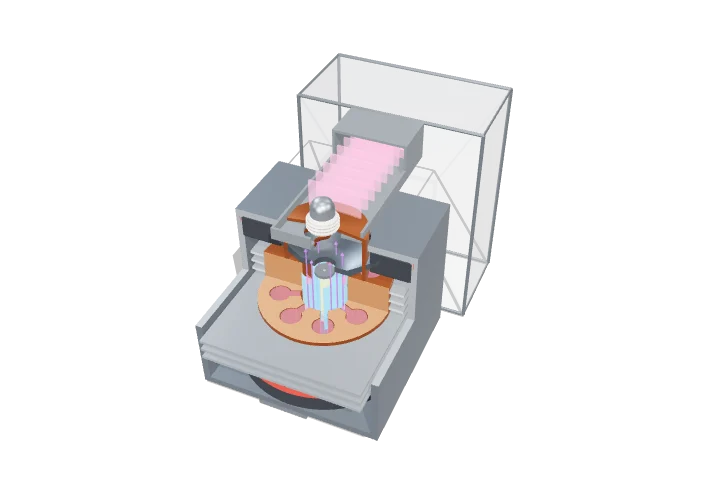 Open the interactive 3D model →
What is the glowing-hot gadget inside a microwave oven, and how does it make invisible waves?
Inside every microwave oven is a small vacuum tube called a magnetron. A hot wire at its centre gives off electrons, and strong magnets make them swirl round instead of flying straight to the copper wall. As they swirl past little holes cut into the copper, they make those holes “ring” with microwaves, the way blowing across a bottle makes it hum.
A cavity magnetron is a crossed-field vacuum tube: a radial electric field and an axial magnetic field make electrons from a hot cathode drift around it instead of crossing straight to the anode. Resonant cavities cut into the copper anode bunch that drifting cloud into rotating spokes, which hand their energy to a microwave field — about 1 kW at 2.45 GHz in a domestic oven.
Key facts
- Oven frequency
- 2.45 GHz (free-space λ ≈ 12.2 cm)
- Anode voltage
- ≈ 4 kV (cathode negative, anode earthed)
- Anode current
- ≈ 0.3 A average
- RF output
- ≈ 600–1,200 W continuous
- Efficiency
- ≈ 65–75 % DC to RF
- Axial magnetic field
- ≈ 0.15–0.2 T in the interaction space
Parts you can explore (13)
- Anode block
- Resonant cavities
- Cathode
- Electron spokes
- Pole pieces
- Permanent magnets
- Steel yoke
- Cooling fins
- Antenna
- Magnetic field
- Waveguide
- Oven cavity
- Filter box
In the 3D model
Rotate and take apart the model, follow a guided tour of what each part does and why it’s needed, change it with a live slider, and test yourself with a short quiz. Free, no sign-up.
OpenArc Models’ models are simplified teaching schematics. Terms · Privacy