Electromagnetism & electronics
Maglev linear motor
Electromagnetism · Linear motors
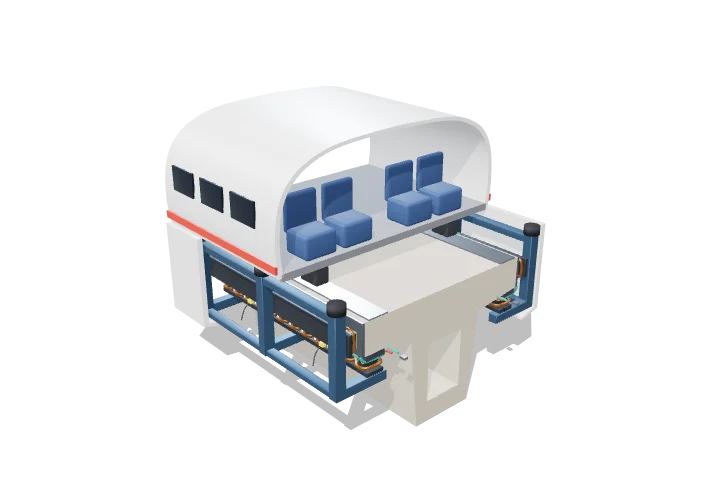 Open the interactive 3D model →
How can a train race along at 430 km/h without ever touching its track?
A maglev train hangs beneath its track, held up by electromagnets that pull upwards towards iron about 1 cm away. Electric cables in the track make a magnetic wave that runs along it, and the train’s magnets get carried along by that wave. Make the wave faster and the train goes faster.
An electromagnetic-suspension (EMS) maglev hangs its vehicle beneath a guideway, using actively controlled electromagnets attracted to an iron stator about 10 mm away. The same magnets act as the moving field of a long-stator linear synchronous motor, whose three-phase guideway windings create a magnetic wave that travels at v = 2τf and carries the vehicle with it.
Key facts
- Levitation gap
- ≈ 8–12 mm (nominal ≈ 10 mm)
- Stator pole pitch τ
- 0.258 m (Transrapid)
- Speed–frequency relation
- v = 2τf; ≈ 270 Hz → 500 km/h
- Shanghai maglev
- 30.5 km line; 431 km/h in service 2004–2021, ≈ 300 km/h since
- Gap control rate
- Gap measured thousands of times per second
- Contact with guideway
- None while levitating — no wheels, rails or overhead wire
Parts you can explore (11)
- Guideway beam
- Long stator
- Stator windings
- Levitation magnets
- Guidance magnets
- Guidance rails
- Levitation frame
- Vehicle body
- Magnetic field
- Gap sensors
- Support skids
In the 3D model
Rotate and take apart the model, follow a guided tour of what each part does and why it’s needed, change it with a live slider, and test yourself with a short quiz. Free, no sign-up.
Open Maglev linear motor in 3D →
OpenArc Models’ models are simplified teaching schematics. Terms · Privacy