Mechanisms
MacPherson strut suspension
Mechanisms · Vehicle dynamics
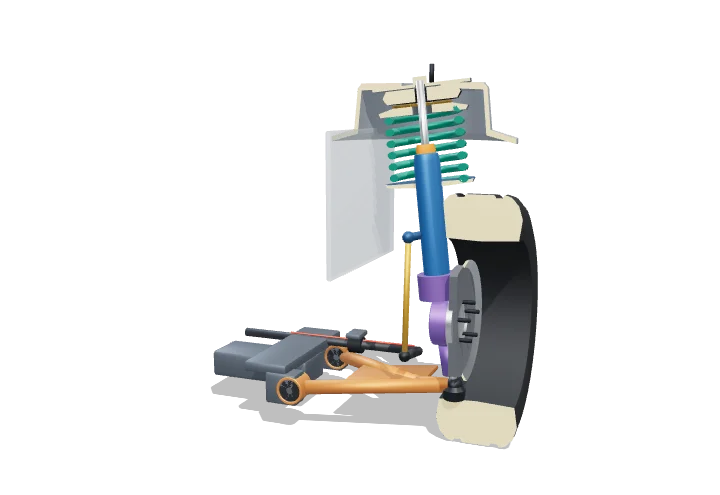 Open the interactive 3D model →
How does a car’s wheel bounce over a pothole while the people inside barely feel it?
Each front wheel of most small cars hangs on a MacPherson strut: a tall spring wrapped round a shock absorber, with one arm underneath. When the wheel hits a bump it rises, squashing the spring, while the shock absorber stops it bouncing up and down afterwards. Clever design lets the same strut also hold the wheel in place and turn it for steering.
A MacPherson strut is an independent suspension in which a telescopic damper, clamped rigidly to the wheel knuckle, acts as both the shock absorber and the upper locating link, with a single lower control arm below. It is compact, light and cheap, which is why most front-wheel-drive cars use it, but its geometry gives relatively little camber control as the wheel moves.
Key facts
- Locating members
- strut (top) + one lower control arm (bottom)
- Wheel travel (model)
- ±80 mm bump / rebound
- Spring rate (model)
- 30 N/mm; motion ratio ≈ 1
- Camber change (model)
- ≈ −0.3° at +40 mm bump; +1.2° at 80 mm rebound
- Strut inclination (model)
- ≈ 6° from vertical
- Ride frequency, typical car
- ≈ 1.0–1.5 Hz
Parts you can explore (12)
- Top mount
- Coil spring
- Damper
- Piston rod
- Steering knuckle
- Wheel hub and brake
- Lower control arm
- Ball joint
- Anti-roll bar link
- Anti-roll bar
- Wheel and tyre
- Body and subframe
In the 3D model
Rotate and take apart the model, follow a guided tour of what each part does and why it’s needed, change it with a live slider, and test yourself with a short quiz. Free, no sign-up.
Open MacPherson strut suspension in 3D →
OpenArc Models’ models are simplified teaching schematics. Terms · Privacy