Human body
Lymph node
Anatomy · Lymphatic and immune system
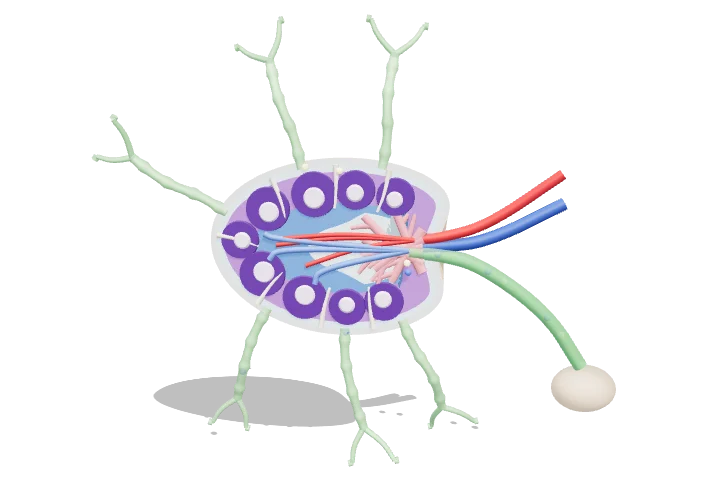 Open the interactive 3D model →
Why do the "glands" in your neck swell up when you have a sore throat?
Lymph nodes are bean-sized checkpoints along vessels that drain fluid (lymph) from your tissues. As lymph trickles through, immune cells inside check it for germs. When they find one, the matching cells multiply fast to fight it — and that crowd of new cells makes the node swell.
Lymph nodes are small encapsulated organs placed along lymphatic vessels that filter lymph and bring antigens together with the lymphocytes able to recognise them. Their organised zones — B-cell follicles, the T-cell paracortex and the medulla — let a rare antigen-specific cell find its antigen, become activated and launch an adaptive immune response.
Key facts
- Number in the body
- ≈ 450–600
- Size, resting
- ≈ 0.2–2 cm (most < 1 cm)
- Lymph returned to blood
- ≈ 2–4 L/day (mostly via the thoracic duct)
- Route of lymphocyte entry
- Mostly from blood through HEVs (commonly quoted ≈ 90%)
- Time a T cell spends in a node
- ≈ 12–24 h before leaving
- Germinal centre formation
- Visible within ≈ 4–7 days of immunisation
Parts you can explore (13)
- Capsule
- Trabeculae
- Subcapsular sinus
- Cortex
- Lymphoid follicles
- Germinal centres
- Paracortex
- Medulla
- Afferent lymphatics
- Efferent lymphatic
- Hilum blood vessels
- Lymphatic network
- Lymph flow
In the 3D model
Rotate and take apart the model, follow a guided tour of what each part does and why it’s needed, change it with a live slider, and test yourself with a short quiz. Free, no sign-up.
OpenArc Models’ models are simplified teaching schematics. Terms · Privacy