Human body
Lungs and airway
Anatomy · Respiratory system
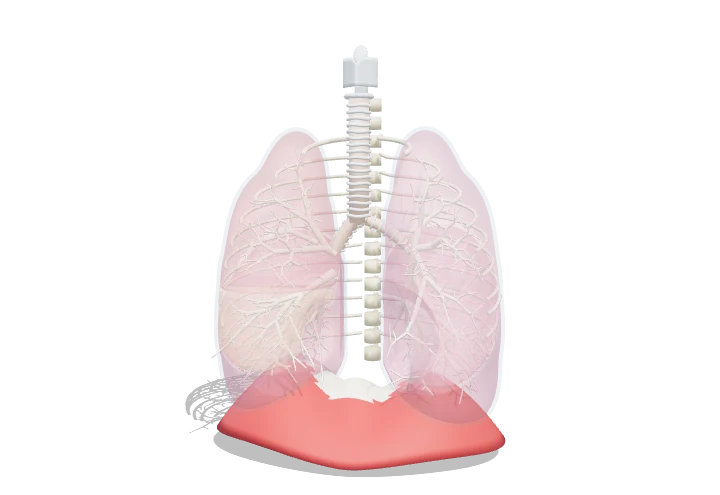 Open the interactive 3D model →
Your lungs have no muscles for breathing — so what actually pulls the air in?
When you breathe in, a dome-shaped muscle under your lungs, the diaphragm, pulls down and your ribs swing up and out. That makes your chest bigger, and the lungs, stuck to the inside of the chest by a thin film of fluid, stretch and suck air in. Air travels down your windpipe and through ever-smaller branching tubes into the lungs.
Air reaches the gas-exchange surface through a branching conducting airway — larynx, trachea, bronchi and bronchioles — housed in a three-lobed right lung and a two-lobed left lung. Breathing works by changing thoracic volume: the diaphragm and intercostal muscles enlarge the chest, the pleura couples the lungs to it, and elastic recoil returns them at rest.
Key facts
- Trachea
- ≈ 10–12 cm long, ≈ 2 cm diameter, 16–20 C-shaped rings
- Airway generations
- ≈ 23 (0 = trachea; ~16 conducting, rest respiratory)
- Lobes
- Right 3 (10 segments), left 2 (8–10 segments)
- Tidal volume at rest
- ≈ 500 mL (≈ 6–8 mL/kg)
- Resting breathing rate
- ≈ 12–20 breaths/min
- Total lung capacity
- ≈ 6 L (adult male)
Parts you can explore (13)
- Larynx
- Trachea
- Tracheal cartilage rings
- Main bronchi
- Bronchial tree
- Right upper lobe
- Right middle lobe
- Right lower lobe
- Left upper lobe
- Left lower lobe
- Pleura
- Diaphragm
- Rib cage
In the 3D model
Rotate and take apart the model, follow a guided tour of what each part does and why it’s needed, change it with a live slider, and test yourself with a short quiz. Free, no sign-up.
OpenArc Models’ models are simplified teaching schematics. Terms · Privacy