Astronomy & space
Lunar phases
Astronomy · Earth–Moon–Sun geometry
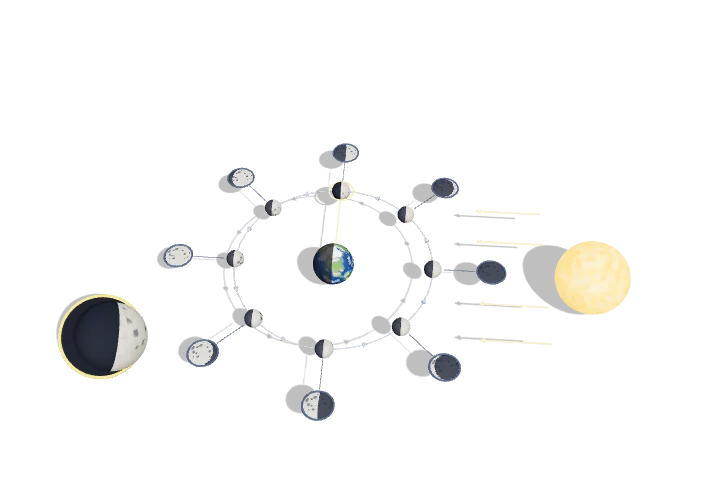 Open the interactive 3D model →
If the Sun always lights half of the Moon, why does the Moon change shape every night?
The Moon makes no light of its own; it shines because the Sun lights it up. At every moment exactly half of the Moon is in sunlight, just like half of Earth is in daytime. As the Moon travels around Earth over about a month, we see different amounts of its sunlit half — from none (new Moon) to all of it (full Moon) and back again.
The Sun always illuminates one half of the Moon, and the phase we see is the fraction of that sunlit half that faces Earth. As the Moon orbits, the angle between the Sun and Moon seen from Earth (the elongation) changes, taking the Moon from new to full and back in one 29.53-day synodic month.
Key facts
- Synodic month (phase cycle)
- 29.53 days
- Sidereal month (orbit relative to stars)
- 27.32 days
- Illuminated fraction
- k = (1 − cos E)/2, E = elongation
- Earth–Moon distance
- 384 400 km mean (≈ 60 Earth radii)
- Moon’s orbital tilt to the ecliptic
- 5.1°
- Moon’s rotation period
- 27.32 days (synchronous)
Parts you can explore (9)
- Sun
- Sunlight
- Earth
- Moon orbit
- Moon at eight positions
- Phases seen from Earth
- Current Moon
- Line of sight
- Current view from Earth
In the 3D model
Rotate and take apart the model, follow a guided tour of what each part does and why it’s needed, change it with a live slider, and test yourself with a short quiz. Free, no sign-up.
OpenArc Models’ models are simplified teaching schematics. Terms · Privacy