Electromagnetism & electronics
Loudspeaker driver
Electroacoustic · Moving coil
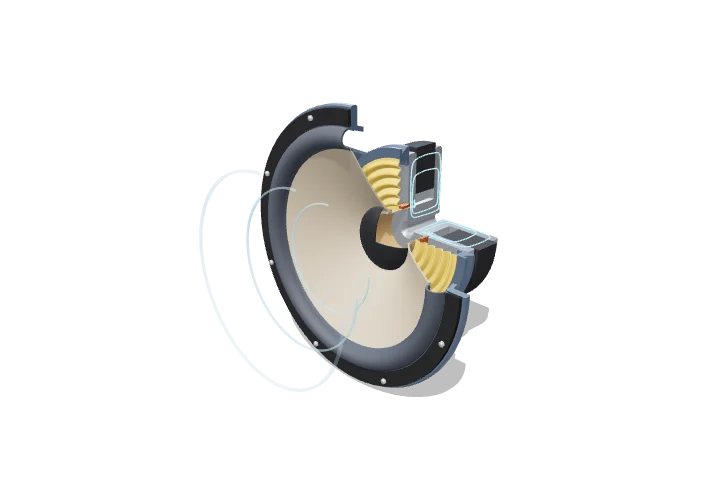 Open the interactive 3D model →
How does an electrical signal in a wire become a voice you can hear across the room?
Inside a loudspeaker a small coil of wire sits next to a strong magnet. When the music signal flows through the coil, the magnet pushes the coil forward and back many times a second. The coil is glued to a paper cone, and the cone pushes the air into the sound waves that reach your ears.
A moving-coil loudspeaker is a linear motor: the audio current in a voice coil sitting in a radial magnetic field feels an axial force F = Bli, which drives a light cone that pushes on the air. The cone, suspension and air load form a mass–spring–damper system summarised by a few Thiele–Small parameters, and only about 1% of the electrical power becomes sound.
Key facts
- Motor force
- F = B l i (force factor Bl ≈ 3–25 T m)
- Gap flux density
- ≈ 0.8–1.5 T
- Nominal impedance
- 4, 6 or 8 Ω (DC resistance ≈ 70–85% of nominal)
- Efficiency (direct radiator)
- ≈ 0.3–2%
- Sensitivity
- ≈ 82–92 dB SPL at 1 W, 1 m (hi-fi); 95–100+ dB (professional)
- Woofer resonance f_s
- ≈ 20–60 Hz
Parts you can explore (11)
- Basket (frame)
- Magnet & pole piece
- Voice coil
- Cone
- Dust cap
- Surround
- Spider
- Terminal tabs
- Tinsel leads
- Magnetic field
- Sound waves
In the 3D model
Rotate and take apart the model, follow a guided tour of what each part does and why it’s needed, change it with a live slider, and test yourself with a short quiz. Free, no sign-up.
Open Loudspeaker driver in 3D →
OpenArc Models’ models are simplified teaching schematics. Terms · Privacy