Human body
Liver lobule
Anatomy · Digestive system · Histology
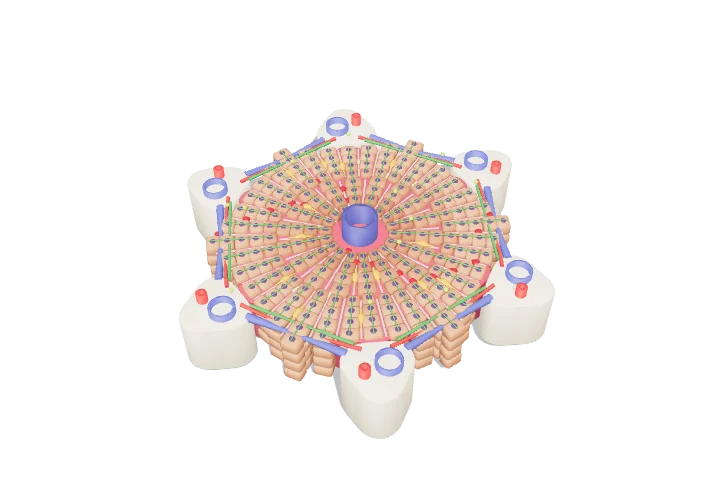 Open the interactive 3D model →
How does your liver check every drop of blood from your gut before it reaches the rest of your body?
Your liver is built from hundreds of thousands of tiny six-sided units called lobules. Blood from your gut and from an artery enters at the corners and trickles inward past rows of liver cells to a vein in the middle. The liver cells clean and process that blood, and send the bile they make outward in the opposite direction.
The liver is built from many thousands of repeating units in which plates of hepatocytes lie between blood-filled sinusoids that run from portal triads to a central vein. Blood flows inward past every hepatocyte while bile, secreted by the same cells, flows outward in canaliculi toward the bile ducts.
Key facts
- Classic lobule size
- ≈ 1–2 mm across, 1.5–2 mm long (hexagonal prism)
- Lobules per liver
- ≈ 50,000 to about 1 million (estimates vary widely with assumed lobule size)
- Hepatic blood flow
- ≈ 1.5 L/min at rest (≈ 25% of cardiac output)
- Inflow split
- ≈ 75% portal vein, ≈ 25% hepatic artery
- Hepatocyte size
- ≈ 20–30 µm, often binucleate
- Bile production
- ≈ 0.5–1 L/day
Parts you can explore (12)
- Hepatocyte plates
- Sinusoids
- Central vein
- Portal vein branch
- Hepatic artery branch
- Bile duct
- Portal tract connective tissue
- Bile canaliculi
- Blood flow
- Bile flow
- Kupffer cells
- Hepatic stellate cells
In the 3D model
Rotate and take apart the model, follow a guided tour of what each part does and why it’s needed, change it with a live slider, and test yourself with a short quiz. Free, no sign-up.
OpenArc Models’ models are simplified teaching schematics. Terms · Privacy