Power & energy
Lithium-ion battery (18650)
Electrochemistry · Energy storage
 Open the interactive 3D model →
What actually moves inside your phone battery when you plug it in?
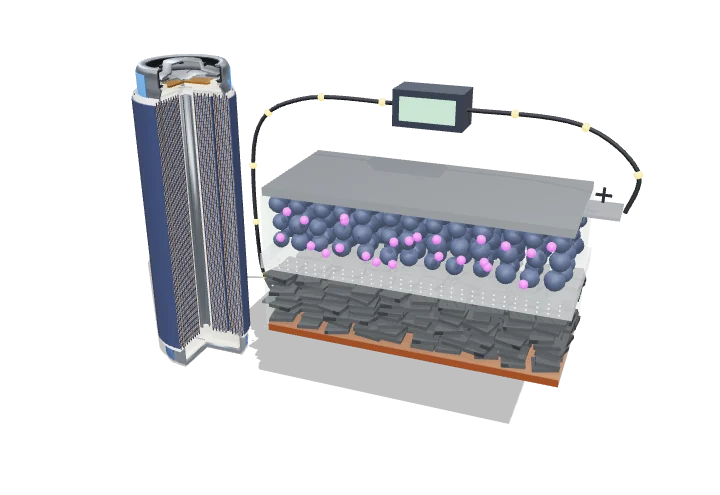
A lithium-ion battery stores energy by moving tiny charged lithium atoms (ions) from one side to the other. Charging pushes them into layers of graphite, the same stuff as pencil lead; using the battery lets them flow back. While the ions travel through the inside, electrons are forced to take the long way round through your phone, and that flow powers it.
A lithium-ion cell stores energy by moving lithium between two host materials: on charge Li⁺ ions leave a layered metal-oxide cathode and intercalate into graphite, and on discharge they return while electrons flow through the external circuit. The large difference in lithium’s chemical potential between the two electrodes gives an average cell voltage of about 3.6–3.7 V and a high energy per kilogram.
Key facts
- 18650 format
- 18 mm diameter × 65 mm long, ≈ 45–48 g
- Capacity (typical 18650)
- ≈ 2.5–3.5 Ah
- Voltage window
- ≈ 2.5–3.0 V empty to 4.2 V full; nominal 3.6–3.7 V
- Specific energy (cell)
- ≈ 200–270 Wh kg⁻¹
- Graphite capacity
- 372 mAh g⁻¹ (theoretical, LiC₆)
- Cycle life
- ≈ 500–2000 full cycles to 80 % capacity, depending on chemistry and use
Parts you can explore (13)
- Steel can
- Jelly roll
- Electrode tabs
- Current interrupt device (CID)
- Positive cap and safety vent
- Copper current collector
- Graphite anode
- Separator
- NMC cathode
- Aluminium current collector
- Electrolyte
- External circuit
- Lithium ions
In the 3D model
Rotate and take apart the model, follow a guided tour of what each part does and why it’s needed, change it with a live slider, and test yourself with a short quiz. Free, no sign-up.
Open Lithium-ion battery (18650) in 3D →
OpenArc Models’ models are simplified teaching schematics. Terms · Privacy