Physics
Three classes of lever
Mechanics · Simple machines and torque
 Open the interactive 3D model →
How can a small child lift a grown-up on a seesaw — and why is your arm built the “wrong” way round?
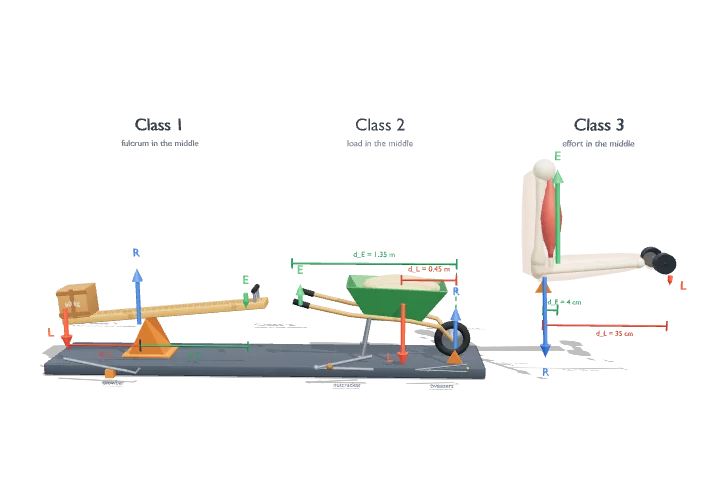
A lever is a stiff bar that turns around a pivot, called the fulcrum. Pushing far from the pivot lets a small force balance a big weight close to it. Where you put the pivot, the push and the weight decides whether the lever gives you more force or more speed.
A lever is a rigid bar that turns about a fulcrum, and it is in equilibrium when the torques of the effort and the load about that fulcrum cancel: E·d_E = L·d_L. Whether a lever multiplies force (class 2), speed and range of motion (class 3) or either (class 1) depends only on the order of fulcrum, load and effort along the bar.
Key facts
- Law of the lever
- E·d_E = L·d_L (torques about the fulcrum)
- Mechanical advantage
- MA = L/E = d_E/d_L
- Class 1 (seesaw)
- MA above or below 1 depending on fulcrum position
- Class 2 (wheelbarrow, model)
- 785 N load, 262 N effort, MA = 3
- Class 3 (forearm, model)
- 98 N dumbbell needs ≈ 860 N of biceps force, MA ≈ 0.11
- Pivot force
- from ΣF = 0: E + L, L − E or E − L for classes 1, 2, 3
Parts you can explore (12)
- Class 1 lever: seesaw
- Class 2 lever: wheelbarrow
- Class 3 lever: forearm
- Fulcrums
- Effort forces
- Load forces
- Fulcrum reactions
- Effort arms
- Load arms
- Class labels
- Base plinths
- Everyday examples
In the 3D model
Rotate and take apart the model, follow a guided tour of what each part does and why it’s needed, change it with a live slider, and test yourself with a short quiz. Free, no sign-up.
Open Three classes of lever in 3D →
OpenArc Models’ models are simplified teaching schematics. Terms · Privacy