Electromagnetism & electronics
Light-emitting diode (LED)
Electronics · Optoelectronics
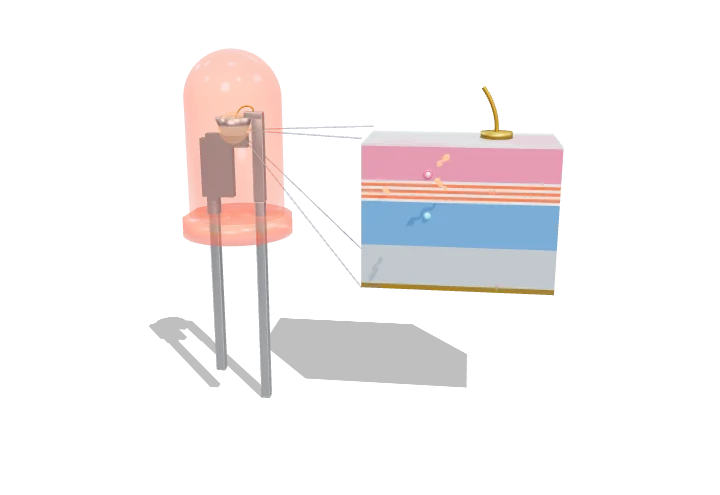 Open the interactive 3D model →
Why does a red LED glow red and a blue one blue, when both are just electricity flowing through a crystal?
An LED is a tiny crystal chip made of two layers: one with spare electrons and one with gaps where electrons are missing, called holes. When current flows, electrons fall into the holes where the layers meet, and each fall gives out a tiny flash of light. The size of the fall, set by the crystal’s material, decides the colour.
A light-emitting diode is a forward-biased p–n junction in which injected electrons and holes recombine and release their energy as photons. The photon energy, and so the colour, is fixed by the band gap of the semiconductor in the active region, while the brightness is set by the current.
Key facts
- Package (shown)
- 5 mm epoxy dome, leads 2.54 mm apart
- Die size
- ≈ 0.25–0.35 mm square for an indicator LED
- Typical operating current
- ≈ 2–20 mA (indicator LEDs)
- Forward voltage
- ≈ 1.8–2.2 V red; ≈ 2.8–3.4 V blue/white
- Colour rule
- λ ≈ 1240 nm·eV / E_g
- Quantum-well thickness
- ≈ 2–4 nm each
Parts you can explore (13)
- Epoxy lens
- Cathode lead
- Anode lead
- Reflector cup
- LED die
- Bond wire
- Substrate
- n-type layer
- Quantum wells
- p-type layer
- Electrodes
- Electrons and holes
- Photons
In the 3D model
Rotate and take apart the model, follow a guided tour of what each part does and why it’s needed, change it with a live slider, and test yourself with a short quiz. Free, no sign-up.
Open Light-emitting diode (LED) in 3D →
OpenArc Models’ models are simplified teaching schematics. Terms · Privacy