Plants & animals
Leaf cross-section
Plant biology · Leaf anatomy
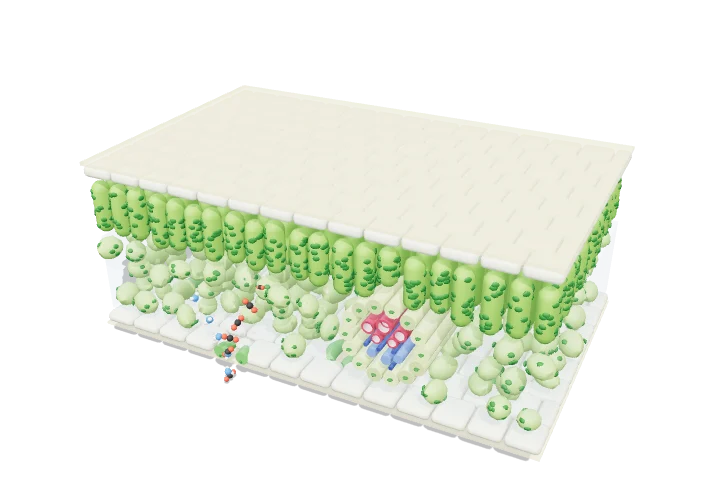 Open the interactive 3D model →
A leaf makes food from air and light — but how does air get inside something so thin?
A leaf is thinner than a credit card, but inside it is built in layers like a sandwich. The top layers catch sunlight, a spongy layer full of air pockets lets carbon dioxide reach every cell, and tiny veins bring water in and carry sugar out. Little mouths on the underside, called stomata, open and close to let air in.
A leaf is a thin, flat organ built to capture light and exchange gases while limiting water loss. Its layered anatomy — cuticle, epidermis, palisade and spongy mesophyll, veins and stomata — balances CO₂ uptake for photosynthesis against the unavoidable loss of water vapour by transpiration.
Key facts
- Typical leaf thickness
- ≈ 0.1–0.5 mm (mesophytic dicot)
- Stomatal density
- ≈ 50–500 mm⁻², mostly on the lower surface in dicots
- Pore length when open
- ≈ 10–40 µm; width ≈ 3–12 µm
- Open stomatal area
- ≈ 0.5–2% of the leaf surface
- Chloroplasts per palisade cell
- ≈ 20–100
- Water lost per CO₂ fixed
- ≈ 200–1,000 H₂O molecules (C₃ plants)
Parts you can explore (12)
- Cuticle
- Upper epidermis
- Palisade mesophyll
- Chloroplasts
- Spongy mesophyll
- Air spaces
- Bundle sheath
- Xylem
- Phloem
- Lower epidermis
- Guard cells
- CO₂ and water vapour
In the 3D model
Rotate and take apart the model, follow a guided tour of what each part does and why it’s needed, change it with a live slider, and test yourself with a short quiz. Free, no sign-up.
Open Leaf cross-section in 3D →
OpenArc Models’ models are simplified teaching schematics. Terms · Privacy