Mechanisms
Lead screw & nut
Linear motion · Screw lead
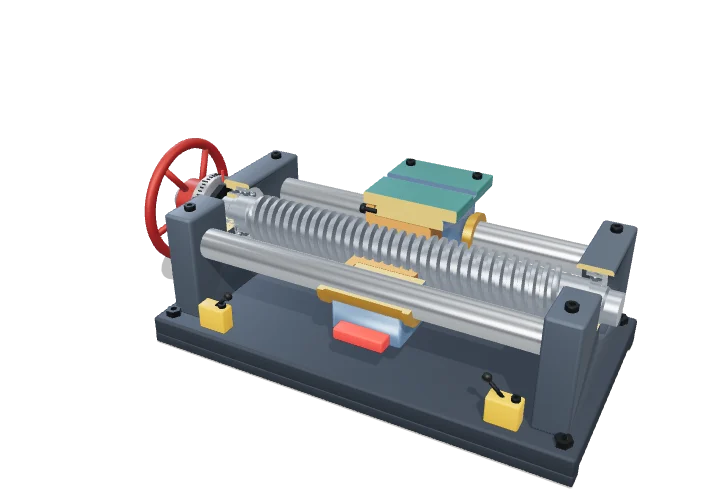 Open the interactive 3D model →
How can turning a wheel by hand move a heavy machine table by a hundredth of a millimetre?
A lead screw is a rod with a spiral groove, like a bolt. A nut on the screw is stopped from spinning, so when the screw turns, the nut has to slide along it. Every full turn moves the nut the same small, exact distance.
A lead screw turns rotation into precise linear motion: each revolution advances a non-rotating nut by one lead, so travel = lead × revolutions. The shallow helix that makes this motion fine also makes sliding friction dominant, which is why plain lead screws are often self-locking but rarely more than 30–70% efficient.
Key facts
- Travel per turn
- Lead L = n × p (n starts, pitch p)
- Model screw
- Tr 20×4: 20 mm diameter, 4 mm pitch, mean diameter ≈ 18 mm
- Model leads
- 4, 8, 12, 16 mm (1–4 starts)
- Trapezoidal thread angle
- 30° included (Acme: 29°)
- Efficiency, sliding lead screw
- ≈ 20–70% (ball screw ≈ 90–95%)
- Self-locking condition
- f sec α > tan λ
Parts you can explore (11)
- Screw
- Nut & carriage
- Carriage mounting plate
- Guide rods
- Guide bushings
- End bearings
- Handwheel
- Base plate
- End limit switches
- Nut lubrication fitting
- Fasteners
In the 3D model
Rotate and take apart the model, follow a guided tour of what each part does and why it’s needed, change it with a live slider, and test yourself with a short quiz. Free, no sign-up.
OpenArc Models’ models are simplified teaching schematics. Terms · Privacy