Power & energy
Lead-acid car battery
Electrochemistry · Energy storage
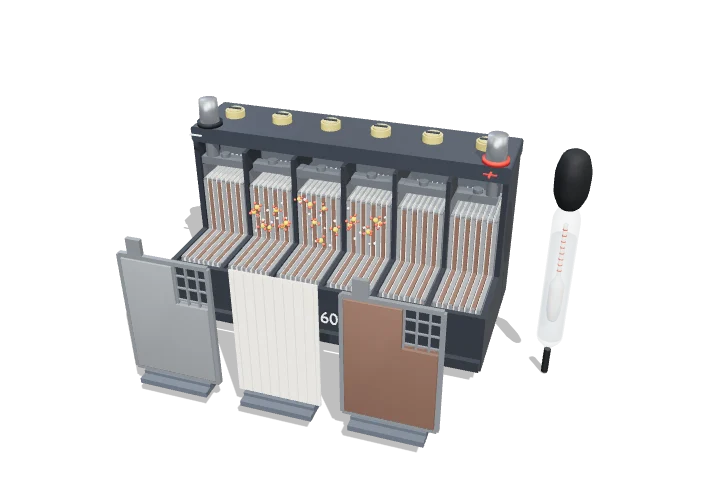 Open the interactive 3D model →
How does a box of lead and acid deliver enough power to spin a car engine on a frosty morning?
A car battery is six small batteries joined in a row, each making about 2 volts. Inside each one, two kinds of lead plates sit in sulfuric acid, and a chemical reaction between them pushes electrons round a circuit. Charging the battery runs that reaction backwards, so it can be used hundreds of times.
A lead-acid battery stores energy in plates of lead dioxide and spongy lead immersed in sulfuric acid; on discharge both plates turn into lead sulfate and the acid is diluted towards water. Six ≈ 2.1 V cells in series make the 12 V battery that starts almost every petrol and diesel car.
Key facts
- Cell voltage (open circuit)
- ≈ 2.10–2.13 V charged; ≈ 1.95–2.0 V discharged
- Battery voltage
- 12.6–12.7 V full; ≈ 11.9 V flat (open circuit, at rest)
- Electrolyte
- H₂SO₄, SG ≈ 1.27–1.28 charged (≈ 35–37 % by mass)
- Specific energy
- ≈ 30–40 Wh kg⁻¹
- Cranking current
- ≈ 400–800 A for a few seconds
- Recycling rate
- > 95 % of lead recovered in many countries
Parts you can explore (12)
- Battery case
- Lid and vent caps
- Terminal posts
- Positive plates (PbO₂)
- Negative plates (Pb)
- Separators
- Lead-alloy grids
- Straps and intercell connectors
- Sulfuric acid electrolyte
- Lead sulfate (PbSO₄)
- Sulfate and hydrogen ions
- Hydrometer
In the 3D model
Rotate and take apart the model, follow a guided tour of what each part does and why it’s needed, change it with a live slider, and test yourself with a short quiz. Free, no sign-up.
Open Lead-acid car battery in 3D →
OpenArc Models’ models are simplified teaching schematics. Terms · Privacy