Chemistry
Le Chatelier’s principle: 2NO₂ ⇌ N₂O₄
Physical chemistry · Chemical equilibrium
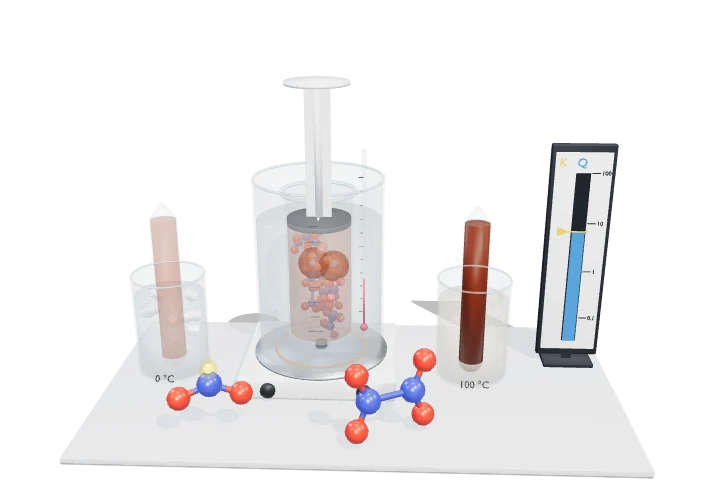 Open the interactive 3D model →
Why does a sealed tube of brown gas turn almost colourless in ice and dark brown in boiling water?
Nitrogen dioxide is a brown gas whose molecules can pair up into a colourless gas, and the pairs can split apart again — both happen all the time. Heating the gas splits more pairs, so it turns browner; cooling it lets more pairs form, so it fades. Whatever you do to the gas, it shifts to partly undo the change: that is Le Chatelier’s principle.
Nitrogen dioxide dimerises reversibly, 2NO₂(g) ⇌ N₂O₄(g), and because NO₂ is brown while N₂O₄ is colourless the position of the equilibrium can be seen directly. Changing temperature changes K through the van ’t Hoff relation, while changing pressure changes only Q — and the system then moves until Q = K again, as Le Chatelier’s principle predicts.
Key facts
- Reaction
- 2NO₂(g) ⇌ N₂O₄(g), ΔH° = −57.2 kJ mol⁻¹
- ΔS°
- −175.8 J mol⁻¹ K⁻¹ (two moles of gas become one)
- Kp at 25 °C
- ≈ 6.9 bar⁻¹ (ΔG° ≈ −4.8 kJ mol⁻¹)
- Kp at 0 °C / 100 °C
- ≈ 57 bar⁻¹ / ≈ 0.07 bar⁻¹
- NO₂ geometry
- bent, O–N–O 134°, N–O 1.20 Å, one unpaired electron
- N₂O₄ geometry
- planar, N–N 1.78 Å (long and weak)
Parts you can explore (12)
- Gas syringe
- NO₂ molecules (brown)
- N₂O₄ molecules (colourless)
- Gas colour
- Water bath & hotplate
- Thermometer
- Ice-bath tube (0 °C)
- Boiling-water tube (100 °C)
- Reaction quotient gauge
- NO₂ structure
- N₂O₄ structure
- Bench
In the 3D model
Rotate and take apart the model, follow a guided tour of what each part does and why it’s needed, change it with a live slider, and test yourself with a short quiz. Free, no sign-up.
Open Le Chatelier’s principle: 2NO₂ ⇌ N₂O₄ in 3D →
OpenArc Models’ models are simplified teaching schematics. Terms · Privacy