Physics
Helium–neon laser
Optics · Lasers
 Open the interactive 3D model →
How does a tube of glowing gas between two mirrors make a perfectly straight red beam?
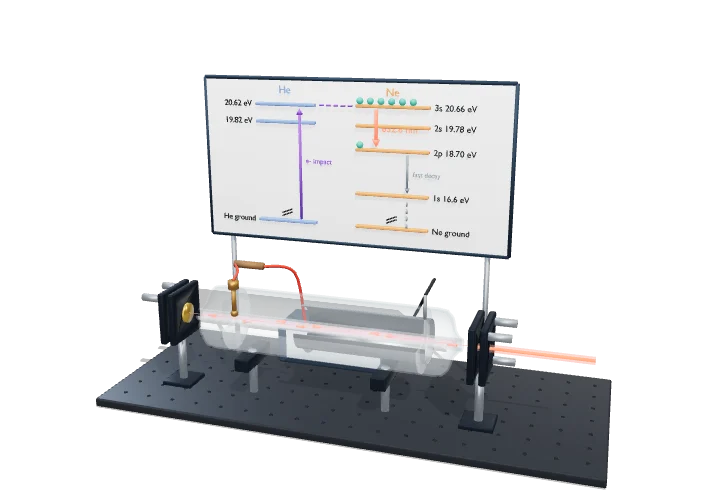
Electricity gives the atoms in the gas extra energy. When a particle of light (a photon) passes an energised atom, it can make the atom release an identical photon, so the light grows stronger. Two mirrors bounce the light back and forth through the gas so it grows again and again, and one mirror lets a little of it escape as the beam.
In a helium–neon laser an electrical discharge excites helium atoms, which transfer their energy by collision to neon and create a population inversion between the neon 3s and 2p levels. Two mirrors turn this optical amplifier into an oscillator: once the round-trip gain exceeds the losses, stimulated emission builds a coherent standing wave at 632.8 nm and a small fraction leaks out through the output coupler as the beam.
Key facts
- Wavelength
- 632.8 nm (red); photon energy 1.96 eV
- Gas fill
- He:Ne ≈ 5:1 to 10:1, total ≈ 1–5 mbar
- Typical output
- 0.5–5 mW (up to ~50 mW in large tubes)
- Operating current
- ≈ 4–8 mA at ≈ 1–2 kV
- Wall-plug efficiency
- ≈ 0.1%
- First operated
- Javan, Bennett & Herriott, Bell Labs, 1960 (1.15 µm)
Parts you can explore (13)
- Plasma tube
- Capillary bore
- He–Ne discharge
- Cathode
- Anode
- High reflector
- Output coupler
- Standing wave
- Stimulated photons
- Output beam
- Power supply
- Energy-level diagram
- Optical breadboard
In the 3D model
Rotate and take apart the model, follow a guided tour of what each part does and why it’s needed, change it with a live slider, and test yourself with a short quiz. Free, no sign-up.
Open Helium–neon laser in 3D →
OpenArc Models’ models are simplified teaching schematics. Terms · Privacy