Human body
Larynx
Anatomy · Respiratory tract & voice
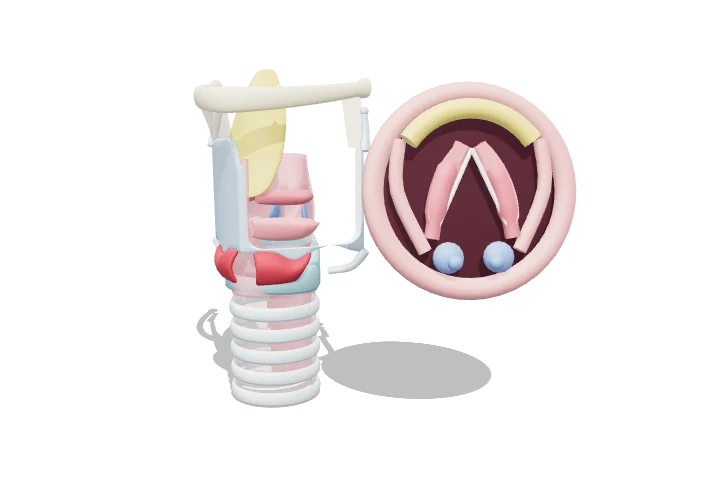 Open the interactive 3D model →
How can two folds of tissue smaller than your thumbnail make every sound from a whisper to an opera note?
Your voice box (larynx) sits at the top of your windpipe. Inside it are two vocal folds that swing apart to let you breathe and come together to make sound. When air from your lungs pushes between the closed folds, they flap open and shut hundreds of times a second, and stretching them tighter raises the pitch.
The larynx is a cartilaginous valve at the top of the trachea that protects the airway, regulates airflow and produces voice. Intrinsic muscles move the arytenoid cartilages to open the glottis for breathing and close it for phonation, while the cricothyroid tilts the thyroid cartilage to tune the tension, and so the pitch, of the vibrating vocal folds.
Key facts
- Vertebral level
- C3 (hyoid) to C6 (lower cricoid border) in adults
- Membranous vocal fold length
- ≈ 15–20 mm in adult men; ≈ 10–14 mm in women
- Speaking F₀
- ≈ 85–155 Hz (men); ≈ 165–255 Hz (women)
- Thyroid angle
- ≈ 90° in men; ≈ 120° in women
- Phonation threshold pressure
- ≈ 0.3–0.5 kPa (3–5 cm H₂O) subglottal
- Glottal area
- up to ≈ 1–2 cm² in deep inspiration; zero at closure
Parts you can explore (12)
- Hyoid bone
- Thyroid cartilage
- Cricoid cartilage
- Arytenoid cartilages
- Epiglottis
- Vocal folds
- Vestibular folds
- Thyrohyoid membrane
- Cricothyroid muscle
- Laryngeal mucosa
- Trachea
- Glottis, superior view
In the 3D model
Rotate and take apart the model, follow a guided tour of what each part does and why it’s needed, change it with a live slider, and test yourself with a short quiz. Free, no sign-up.
OpenArc Models’ models are simplified teaching schematics. Terms · Privacy