Cells & molecules
The lac operon
Molecular biology · Gene regulation
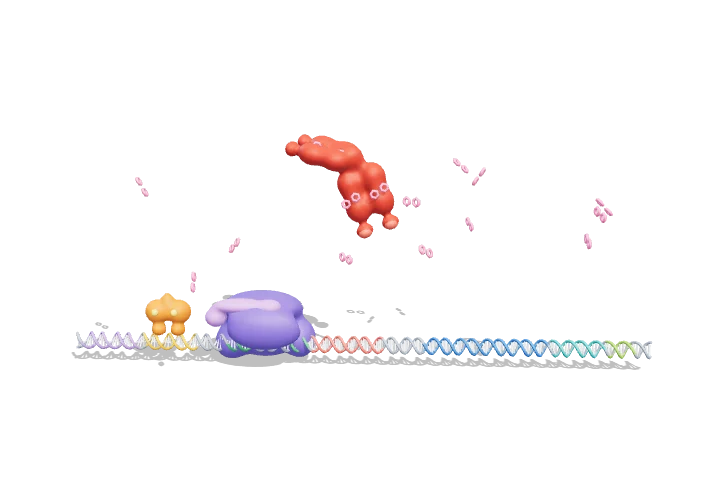 Open the interactive 3D model →
How does a bacterium “decide” to eat milk sugar only when its favourite food has run out?
E. coli bacteria keep three milk-sugar (lactose) genes switched off most of the time, because making the enzymes costs energy. A blocking protein sits on the DNA until lactose appears, and a helper protein only boosts the genes when glucose, the bacterium’s favourite sugar, is scarce. So the genes turn fully on only when lactose is present and glucose is absent.
The lac operon is a cluster of three E. coli genes for lactose use that are transcribed together from one promoter and controlled by two proteins. The Lac repressor blocks transcription unless lactose (as allolactose) is present, and the activator CAP–cAMP boosts it only when glucose is scarce, so the genes are strongly expressed only when lactose is available and glucose is not.
Key facts
- Structural genes
- lacZ 3,075 bp, lacY 1,254 bp, lacA 612 bp
- Lac repressor
- LacI tetramer, 4 × 360 amino acids (≈ 150 kDa)
- Repressor copies per cell
- ≈ 10 tetramers
- Operators
- O1 (centred at +11), O2 (+401, in lacZ), O3 (−82)
- CAP site
- centred at −61.5; DNA bent ≈ 90°
- Induction
- ≈ 1,000-fold from fully repressed to induced
Parts you can explore (13)
- DNA
- lacI gene
- CAP site
- Promoter
- Operator
- lacZ
- lacY
- lacA
- Lac repressor
- RNA polymerase
- CAP–cAMP
- Allolactose
- mRNA
In the 3D model
Rotate and take apart the model, follow a guided tour of what each part does and why it’s needed, change it with a live slider, and test yourself with a short quiz. Free, no sign-up.
OpenArc Models’ models are simplified teaching schematics. Terms · Privacy