Human body
Knee joint
Anatomy · Synovial hinge joint
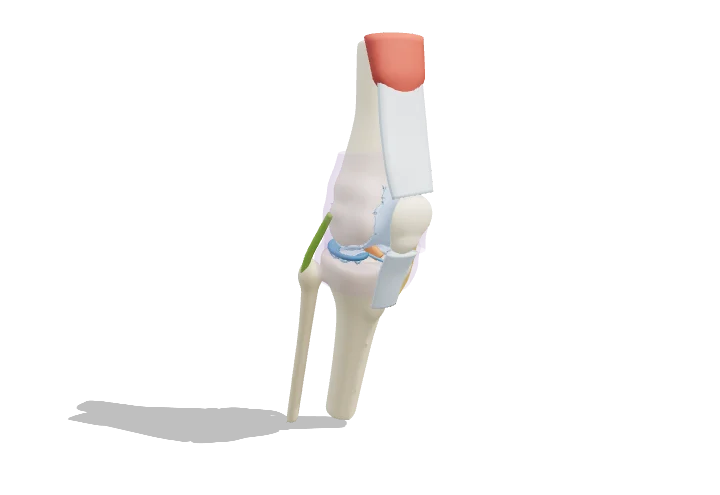 Open the interactive 3D model →
If the knee’s bones barely fit together, why doesn’t it fall apart every time you jump?
Your knee joins the thigh bone (femur) to the shin bone (tibia), but their ends do not fit snugly — a rounded end sits on an almost flat top. Rubbery pads called menisci and four strong ligaments hold the joint together, and the kneecap helps your thigh muscles straighten the leg.
The knee is the largest synovial joint in the body: a modified hinge in which rounded femoral condyles roll and glide on nearly flat tibial plateaus. Because the bones fit poorly, stability comes from the menisci, the cruciate and collateral ligaments, the capsule and the muscles that cross it.
Key facts
- Joint type
- Synovial, modified hinge (bicondylar), plus patellofemoral joint
- Range of motion
- ≈ 0–140° active flexion; ~160° passive
- Tibiofemoral load
- ≈ 2–3 × body weight walking; 4–6 × on stairs
- Cartilage thickness
- ≈ 2–4 mm (femur, tibia); up to ~5 mm behind the patella
- ACL length × width
- ≈ 32–38 mm × 10–11 mm
- Femoral rollback
- lateral condyle ≈ 15–20 mm, medial ≈ 3–5 mm over full flexion
Parts you can explore (14)
- Femur
- Tibia
- Fibula
- Patella
- Articular cartilage
- Medial meniscus
- Lateral meniscus
- ACL
- PCL
- MCL
- LCL
- Quadriceps tendon
- Patellar tendon
- Synovial capsule
In the 3D model
Rotate and take apart the model, follow a guided tour of what each part does and why it’s needed, change it with a live slider, and test yourself with a short quiz. Free, no sign-up.
OpenArc Models’ models are simplified teaching schematics. Terms · Privacy