Cells & molecules
Kinesin motor
Cell biology · Molecular motor
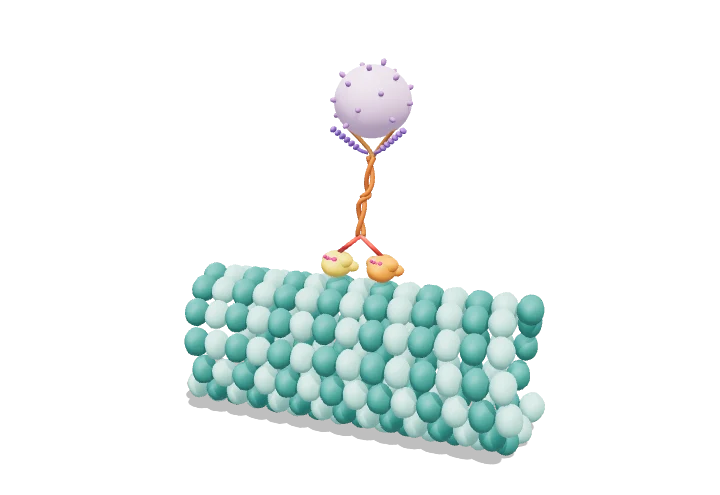 Open the interactive 3D model →
How does a nerve cell a metre long deliver supplies from its centre to its far tip?
Inside your cells, tiny protein “walkers” called kinesins carry packages along stiff tracks called microtubules. Each kinesin has two feet that step over each other, 8 billionths of a metre at a time, and every step is paid for with one molecule of the cell’s fuel, ATP.
Kinesin-1 is a two-headed motor protein that walks toward the plus end of microtubules, taking one 8 nm step for each ATP it hydrolyses. Its heads alternate in a hand-over-hand cycle coordinated by the neck linkers, so a single molecule can haul cargo about a micrometre before letting go.
Key facts
- Step size
- 8 nm per ATP (one tubulin dimer)
- Maximum speed (in vitro)
- ≈ 0.8 µm/s ≈ 100 steps/s
- Stall force
- ≈ 6–7 pN
- Run length
- ≈ 1 µm (≈ 100+ steps) per binding event
- Microtubule
- 25 nm diameter, 13 protofilaments, 8 nm dimer repeat
- Direction
- Toward the microtubule plus end (outward, anterograde, in axons)
Parts you can explore (8)
- α-tubulin
- β-tubulin
- Motor heads
- Nucleotide (ATP/ADP)
- Neck linkers
- Coiled-coil stalk
- Light chains and tail
- Cargo vesicle
In the 3D model
Rotate and take apart the model, follow a guided tour of what each part does and why it’s needed, change it with a live slider, and test yourself with a short quiz. Free, no sign-up.
OpenArc Models’ models are simplified teaching schematics. Terms · Privacy