Human body
Kidney
Anatomy · Urinary system
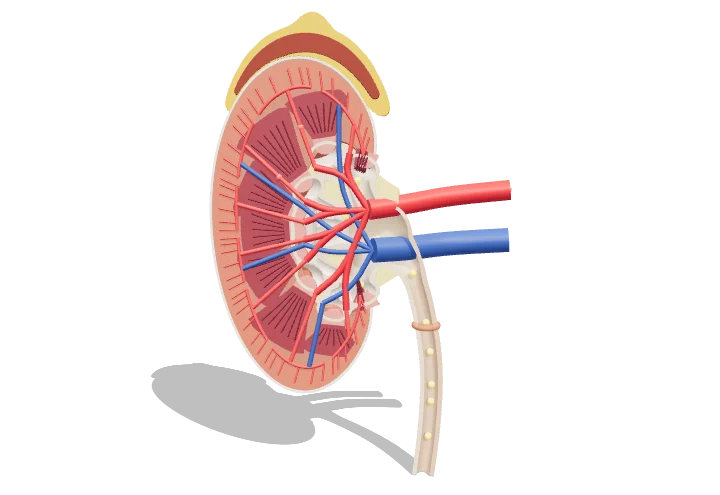 Open the interactive 3D model →
Why do two kidneys, each smaller than your fist, get about a fifth of all the blood your heart pumps?
Your kidneys clean your blood. They filter out water and waste, keep what your body needs and send the rest away as urine. They need a huge blood flow because cleaning, not oxygen, is their job: they filter about 180 litres of fluid a day and return almost all of it.
Each kidney is a bean-shaped organ whose outer cortex and inner medullary pyramids house about a million nephrons, drained by calyces into the renal pelvis and ureter. Although the kidneys are only about 0.5% of body mass, they receive roughly a fifth of the cardiac output, which they filter to regulate fluid volume, electrolytes, acid–base balance and waste excretion.
Key facts
- Size (adult)
- ≈ 10–12 cm long, 5–7 cm wide, 3 cm thick
- Mass
- ≈ 120–170 g each
- Renal blood flow
- ≈ 1.1–1.2 L/min (≈ 20–25% of cardiac output)
- GFR (both kidneys)
- ≈ 125 mL/min ≈ 180 L/day
- Renal pyramids
- ≈ 8–18 per kidney
- Urine output
- ≈ 1–2 L/day
Parts you can explore (15)
- Renal capsule
- Renal cortex
- Renal pyramids
- Renal columns
- Renal papillae
- Minor calyces
- Major calyces
- Renal pelvis
- Ureter
- Renal artery
- Renal vein
- Interlobar & arcuate arteries
- Renal sinus fat
- Adrenal gland
- Urine flow
In the 3D model
Rotate and take apart the model, follow a guided tour of what each part does and why it’s needed, change it with a live slider, and test yourself with a short quiz. Free, no sign-up.
OpenArc Models’ models are simplified teaching schematics. Terms · Privacy