Physics
Kepler orbits
Gravitation · Celestial mechanics
 Open the interactive 3D model →
Why do planets speed up as they swing close to the Sun and slow down far away?
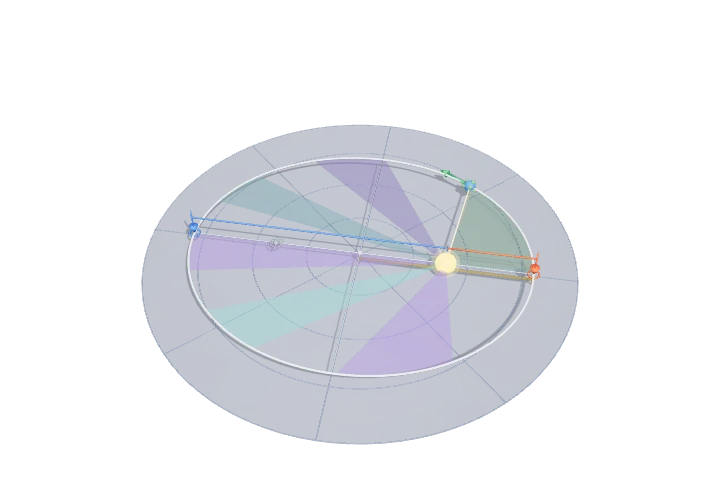
Planets do not travel in perfect circles. They follow stretched circles called ellipses, with the Sun off to one side. The Sun’s gravity speeds a planet up as it falls closer and slows it as it climbs away, in a precise pattern Johannes Kepler discovered 400 years ago.
Under the Sun’s inverse-square gravity a planet moves on an ellipse with the Sun at one focus, sweeps out equal areas in equal times, and has a period that depends only on the semi-major axis. These are Kepler’s three laws, which Newton showed follow from conservation of angular momentum and energy in a 1/r² central force.
Key facts
- Model semi-major axis
- a = 1 AU (fixed) → T = 1 year at every e
- Earth’s eccentricity
- e = 0.0167 (r_p 0.983 AU, r_a 1.017 AU)
- Earth’s orbital speed
- 30.29 km/s at perihelion, 29.29 km/s at aphelion
- Speed ratio
- v_p / v_a = (1 + e)/(1 − e)
- Halley’s Comet
- e ≈ 0.967, a ≈ 17.8 AU, T ≈ 75–76 yr
- Kepler’s third law (solar units)
- T² [yr²] = a³ [AU³]
Parts you can explore (12)
- Sun
- Elliptical orbit
- Planet
- Equal-area sectors
- Perihelion
- Aphelion
- Semi-major axis
- Empty focus
- Radius vector
- Velocity vector
- Minor axis
- Orbital plane
In the 3D model
Rotate and take apart the model, follow a guided tour of what each part does and why it’s needed, change it with a live slider, and test yourself with a short quiz. Free, no sign-up.
OpenArc Models’ models are simplified teaching schematics. Terms · Privacy