Earth & space
Karst caves
Earth science · Karst geomorphology
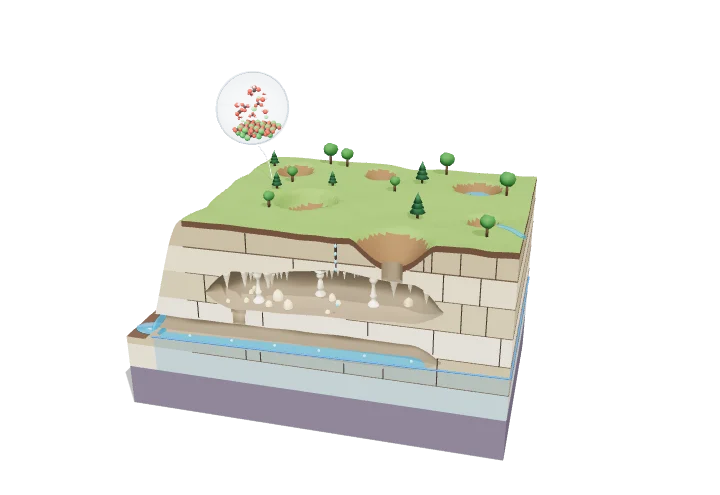 Open the interactive 3D model →
How can rainwater — weaker than lemon juice — hollow out caves big enough to fit a skyscraper?
Limestone is a rock that slowly dissolves in slightly acidic water, a bit like sugar in tea but far slower. Rain soaks through soil, picks up carbon dioxide and becomes a weak acid that widens cracks in the limestone over tens of thousands of years until they become caves. Later, drips of that water leave tiny crusts of stone behind, building stalactites and stalagmites.
Karst is the landscape that forms where soluble rock, mainly limestone, is dissolved by water carrying carbon dioxide, so drainage moves underground through enlarged fractures and caves. The same chemistry runs in reverse in drained caves, where degassing drip water deposits calcite as stalactites, stalagmites and columns.
Key facts
- Key reaction
- CaCO₃ + H₂O + CO₂ ⇌ Ca²⁺ + 2HCO₃⁻
- Soil-air CO₂
- ≈ 1–10% by volume (atmosphere ≈ 0.04%)
- Calcite dissolved at equilibrium
- ≈ 50 mg/L CaCO₃ at atmospheric CO₂; several hundred mg/L at soil CO₂
- Passage wall retreat
- ≈ 0.01–1 mm/yr in actively enlarging conduits
- Speleothem growth
- ≈ 0.01–1 mm/yr, commonly ~0.1 mm/yr
- Karst extent
- roughly 10–15% of ice-free land; a major drinking-water source
Parts you can explore (13)
- Limestone strata
- Shale base
- Soil and vegetation
- Sinkholes
- Joints and bedding planes
- Cave passage
- Stalactites
- Stalagmites
- Columns
- Underground river
- Water table
- Spring
- Dissolution chemistry
In the 3D model
Rotate and take apart the model, follow a guided tour of what each part does and why it’s needed, change it with a live slider, and test yourself with a short quiz. Free, no sign-up.
OpenArc Models’ models are simplified teaching schematics. Terms · Privacy