Astronomy & space
James Webb Space Telescope
Astronomy · Infrared observatory
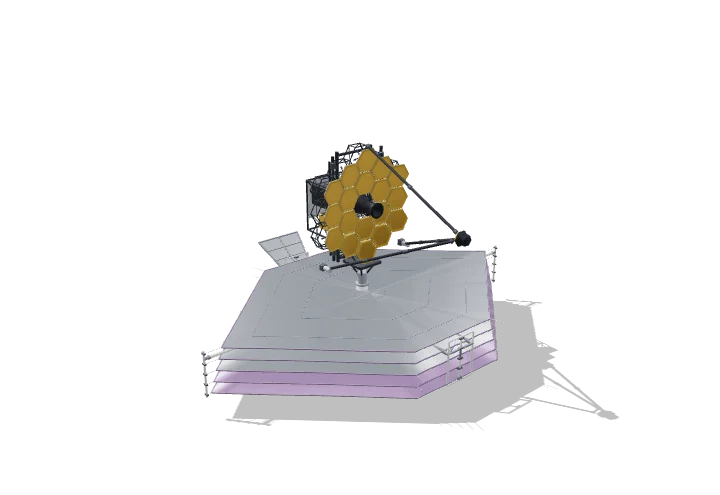 Open the interactive 3D model →
How do you photograph galaxies that formed more than 13 billion years ago — with a telescope that has to stay colder than −230 °C?
The James Webb Space Telescope is a giant space telescope with a gold mirror 6.5 m wide, launched in 2021. It sees infrared light — the kind of “heat light” our eyes cannot see — which carries signals from the very first galaxies and from planets around other stars. Because warm things glow in infrared, Webb hides behind a sunshield the size of a tennis court to stay extremely cold.
The James Webb Space Telescope is a 6.5 m infrared observatory launched on 25 December 2021 and operating near the Sun–Earth L2 point, 1.5 million km from Earth. Its gold-coated segmented mirror and five-layer sunshield let it see faint, redshifted light from the first galaxies and the atmospheres of exoplanets.
Key facts
- Primary mirror
- 6.5 m, 18 beryllium segments, ≈ 25.4 m² collecting area
- Wavelength range
- 0.6–28.5 µm
- Sunshield
- ≈ 21.2 m × 14.2 m, 5 layers of Kapton E
- Operating temperature
- ≈ 40 K (MIRI ≈ 7 K)
- Orbit
- Halo orbit about Sun–Earth L2, ≈ 1.5 × 10⁶ km from Earth
- Launch mass
- ≈ 6,160 kg
Parts you can explore (9)
- Primary mirror (18 segments)
- Secondary mirror and struts
- Integrated science instrument module
- Sunshield (5 layers)
- Pallets, mid-booms and trim flap
- Spacecraft bus
- Deployable tower assembly
- Solar array
- High-gain antenna
In the 3D model
Rotate and take apart the model, follow a guided tour of what each part does and why it’s needed, change it with a live slider, and test yourself with a short quiz. Free, no sign-up.
Open James Webb Space Telescope in 3D →
OpenArc Models’ models are simplified teaching schematics. Terms · Privacy