Astronomy & space
Jupiter
Planetary science · Gas giant
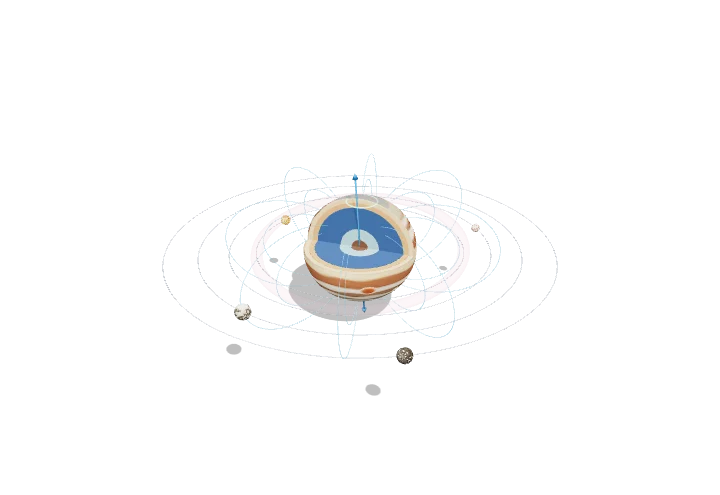 Open the interactive 3D model →
Could you land on Jupiter — and if not, what would you find if you kept falling in?
Jupiter is the biggest planet: more than 1,300 Earths would fit inside it. It is made mostly of hydrogen and helium and has no solid surface — the gas just gets thicker and hotter the deeper you go, until it turns into a liquid metal. It spins in under 10 hours, which stretches its clouds into stripes, and its four big moons orbit in a perfect rhythm.
Jupiter is a hydrogen–helium giant with 318 Earth masses, a 10-hour day and no solid surface: its banded clouds sit on top of a deep fluid interior that becomes metallic under extreme pressure. Its powerful magnetic field and its four large moons, locked in orbital resonance, make it a miniature planetary system.
Key facts
- Equatorial / polar radius
- 71,492 km / 66,854 km (flattening 0.065)
- Mass
- 1.898 × 10²⁷ kg ≈ 318 Earth masses
- Mean density
- 1.33 g cm⁻³
- Rotation period (System III)
- 9 h 55 min 30 s
- Orbit
- 5.20 AU from the Sun; 11.86-year period
- Magnetic dipole tilt
- ≈ 9.6° to the spin axis
Parts you can explore (12)
- Atmospheric bands
- Great Red Spot
- Molecular hydrogen layer
- Metallic hydrogen layer
- Core
- Magnetic field lines
- Io plasma torus
- Io
- Europa
- Ganymede
- Callisto
- Moon orbits
In the 3D model
Rotate and take apart the model, follow a guided tour of what each part does and why it’s needed, change it with a live slider, and test yourself with a short quiz. Free, no sign-up.
OpenArc Models’ models are simplified teaching schematics. Terms · Privacy