Power & energy
Turbojet engine (cutaway)
Aerospace · Gas turbine (Brayton cycle)
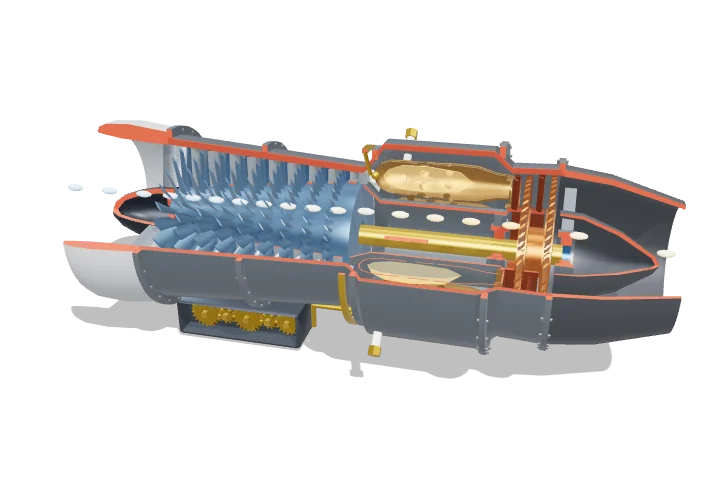 Open the interactive 3D model →
How can an engine with no propeller push a fighter jet faster than sound?
A jet engine swallows air, squeezes it hard with spinning fans of small blades, then burns fuel in it so it gets very hot. The hot gas spins a turbine on its way out and then shoots from the back as a fast jet. Throwing all that gas backwards pushes the engine forwards.
A turbojet is an open Brayton-cycle machine: an axial compressor raises the pressure of incoming air, fuel burns at nearly constant pressure in the combustion chambers, and a turbine extracts just enough work to drive the compressor. The remaining energy accelerates the gas through the nozzle, and the rate of change of the flow’s momentum is the thrust.
Key facts
- Ideal cycle
- Brayton: 2 isentropic + 2 isobaric processes
- This model at full speed
- π ≈ 12, ṁ ≈ 75 kg/s, T₄ ≈ 1,200 K, ideal thrust ≈ 59 kN
- Ideal efficiency at π = 12
- ≈ 51% (γ = 1.4)
- Turbine entry temperature
- ≈ 1,100–1,250 K (1950s turbojets) → ≈ 1,800–2,000 K (modern engines)
- Overall air–fuel ratio
- ≈ 50–70 : 1 (stoichiometric ≈ 15 : 1)
- Jet fuel energy
- ≈ 43 MJ/kg (lower heating value)
Parts you can explore (12)
- Air intake
- Compressor
- Compressor stators
- Combustion chambers
- Fuel nozzles & igniters
- Nozzle guide vanes
- Turbine
- Shaft & bearings
- Outer casing
- Exhaust nozzle
- Accessory gearbox
- Gas flow
In the 3D model
Rotate and take apart the model, follow a guided tour of what each part does and why it’s needed, change it with a live slider, and test yourself with a short quiz. Free, no sign-up.
Open Turbojet engine (cutaway) in 3D →
OpenArc Models’ models are simplified teaching schematics. Terms · Privacy