Plants & animals
Jellyfish (moon jelly)
Cnidarians · Medusa
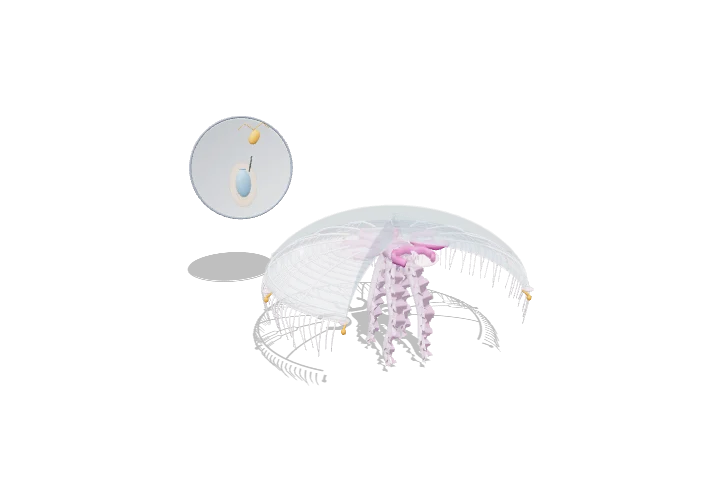 Open the interactive 3D model →
How does an animal with no brain, no bones and no heart swim, hunt and know which way is up?
A moon jelly is about 95% water: a soft bell of jelly with a thin layer of living cells on each side. It swims by squeezing its bell shut with a ring of muscle and letting the springy jelly pop it open again. Tiny stinging capsules on its tentacles catch the plankton it eats.
The moon jelly Aurelia aurita is the medusa stage of a scyphozoan cnidarian: a bell of watery mesoglea sandwiched between two thin cell layers, with a branching gut, four horseshoe gonads and a rim of sense organs and stinging tentacles. It swims by pulsing — a fast muscular contraction followed by elastic recoil of the jelly — and catches plankton with nematocysts.
Key facts
- Bell diameter
- Usually 10–25 cm; up to ≈ 40 cm
- Water content
- ≈ 95–98% of body mass
- Pulse rate
- ≈ 0.3–1 Hz, faster in small medusae
- Rhopalia
- 8, in notches of the bell margin
- Gonads
- 4, horseshoe-shaped, in the gastric pouches
- Nematocyst discharge
- ≈ 700 ns; accelerations up to ~5 × 10⁶ g
Parts you can explore (9)
- Exumbrella
- Subumbrella
- Mesoglea
- Gastric pouches and gonads
- Radial canals
- Oral arms
- Marginal tentacles
- Rhopalia
- Nematocyst firing (inset)
In the 3D model
Rotate and take apart the model, follow a guided tour of what each part does and why it’s needed, change it with a live slider, and test yourself with a short quiz. Free, no sign-up.
Open Jellyfish (moon jelly) in 3D →
OpenArc Models’ models are simplified teaching schematics. Terms · Privacy