Mechanisms
Jacquard loom
Mechanisms · Textiles & early programming
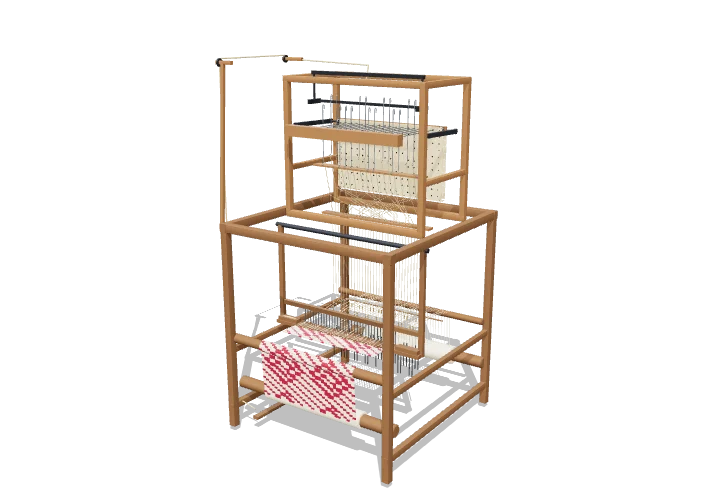 Open the interactive 3D model →
How could a 200-year-old loom weave a silk portrait just by following holes punched in cards?
Cloth is woven by lifting some lengthwise threads and passing a crosswise thread underneath them. The Jacquard loom decides which threads to lift by reading a chain of cards with holes punched in them: a hole means “lift”, no hole means “stay down”. Change the cards and the loom weaves a different picture — an early way of storing instructions that later inspired computers.
The Jacquard mechanism lets a loom lift any combination of warp ends for each pick, selecting them with a chain of punched cards instead of a human draw-boy. It turned a woven pattern into stored, replaceable data and directly inspired the punched cards of Babbage’s Analytical Engine and of 20th-century data processing.
Key facts
- Invented
- Joseph-Marie Jacquard, Lyon, demonstrated 1801–1804
- Typical hooks per head
- ≈ 400–1,300 (later machines several thousand)
- Model
- 16 hooks, 32 warp ends (2× repeat), 24 cards
- Cards per pattern
- one per pick: thousands to tens of thousands for portraits
- Hand-weaving speed
- roughly 1–2 picks per second
- Lift of selected ends
- a few centimetres at the heddles
Parts you can explore (12)
- Loom frame
- Punched cards
- Card cylinder
- Needles
- Hooks
- Griffe
- Harness and mails
- Warp threads
- Reed and batten
- Shuttle
- Woven cloth
- Treadle
In the 3D model
Rotate and take apart the model, follow a guided tour of what each part does and why it’s needed, change it with a live slider, and test yourself with a short quiz. Free, no sign-up.
OpenArc Models’ models are simplified teaching schematics. Terms · Privacy