Chemistry
Ionic bonding: Na + Cl → NaCl
General chemistry · Chemical bonding
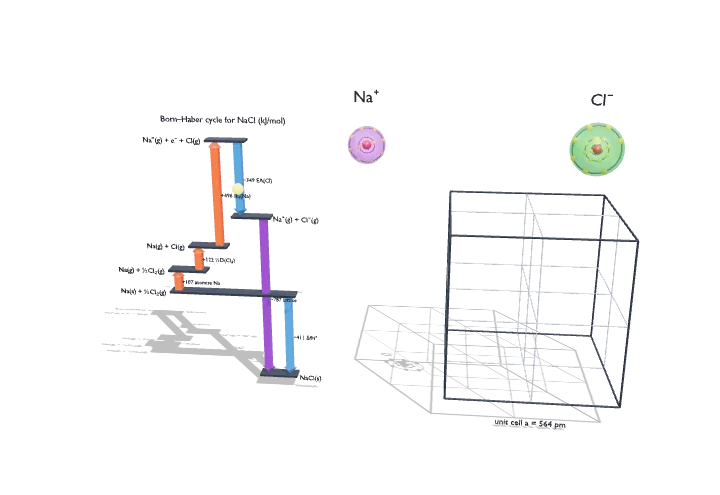 Open the interactive 3D model →
How do a soft, explosive metal and a poisonous green gas combine into the salt on your chips?
A sodium atom has one loosely held outer electron, and a chlorine atom has room for exactly one more. When the electron moves across, sodium becomes a positive ion and chlorine a negative ion, and opposite charges pull together. Millions of these ions stack into a cube-shaped crystal — table salt.
Sodium transfers its single valence electron to chlorine, producing a small Na⁺ cation and a large Cl⁻ anion that attract electrostatically. The energy released when these ions pack into a rock-salt lattice (787 kJ/mol) more than pays for the endothermic steps, so NaCl(s) forms with ΔfH° = −411 kJ/mol.
Key facts
- Ionic radii (CN 6)
- Na⁺ 102 pm, Cl⁻ 181 pm
- Atomic radii
- Na 186 pm (metallic), Cl 99 pm (covalent)
- Na–Cl distance
- 282 pm; unit cell a = 564 pm
- Lattice enthalpy
- 787 kJ/mol (Born–Haber)
- ΔfH°(NaCl, s)
- −411 kJ/mol
- Melting point
- 801 °C
Parts you can explore (10)
- Sodium atom → Na⁺
- Chlorine atom → Cl⁻
- Transferred electron
- Coulomb attraction
- Rock-salt lattice
- Unit-cell edges
- Born–Haber levels
- Endothermic steps
- Exothermic steps
- Lattice energy
In the 3D model
Rotate and take apart the model, follow a guided tour of what each part does and why it’s needed, change it with a live slider, and test yourself with a short quiz. Free, no sign-up.
Open Ionic bonding: Na + Cl → NaCl in 3D →
OpenArc Models’ models are simplified teaching schematics. Terms · Privacy