Cells & molecules
Influenza A virus
Virology · Enveloped RNA virus
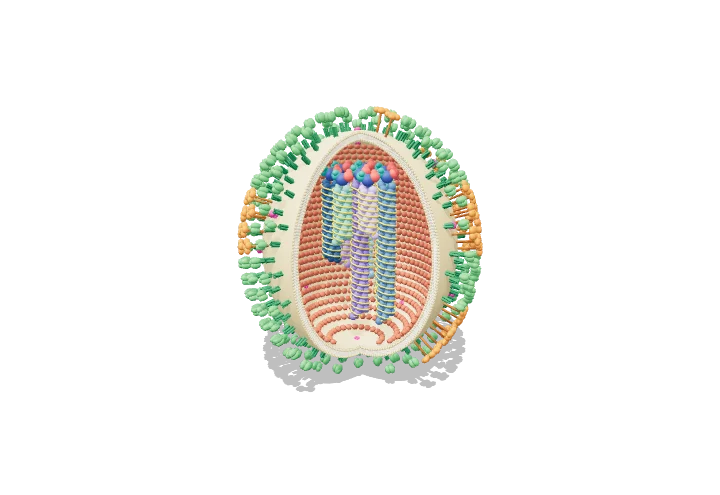 Open the interactive 3D model →
Why do you need a new flu jab every year, when one measles jab lasts a lifetime?
The flu virus is a ball about 100 nm across, covered in two kinds of spike and wrapped in a fatty coat. One spike sticks the virus to a cell; the other cuts it free again when new copies are ready to leave. Inside, its genetic material is not one piece but eight separate ones — and that split genome is a large part of why flu changes so fast.
Influenza A is an enveloped, negative-sense RNA virus whose genome is divided into eight separate ribonucleoprotein segments packed beneath a matrix-protein shell. Its two surface glycoproteins do opposite jobs — hemagglutinin binds and fuses with host cells, neuraminidase releases new virions — and both are the main targets of immunity and antiviral drugs.
Key facts
- Virion size
- ≈ 80–120 nm (spherical); filamentous forms can be several µm long
- Genome
- 8 segments of negative-sense RNA, ≈ 13.6 kb in total
- Surface spikes
- ≈ 300–400 HA trimers and ≈ 40–60 NA tetramers per spherical virion
- HA : NA ratio
- roughly 4–5 : 1 (varies by strain and particle)
- Fusion pH
- ≈ 5.0–6.0, depending on strain
- Subtypes
- 18 HA (H1–H18) and 11 NA (N1–N11)
Parts you can explore (8)
- Lipid envelope
- Hemagglutinin (HA)
- Neuraminidase (NA)
- M2 ion channel
- M1 matrix layer
- Nucleoprotein (NP)
- Viral RNA (vRNA)
- Polymerase complex
In the 3D model
Rotate and take apart the model, follow a guided tour of what each part does and why it’s needed, change it with a live slider, and test yourself with a short quiz. Free, no sign-up.
Open Influenza A virus in 3D →
OpenArc Models’ models are simplified teaching schematics. Terms · Privacy