Power & energy
Inertial confinement fusion
Fusion energy · Laser-driven implosion
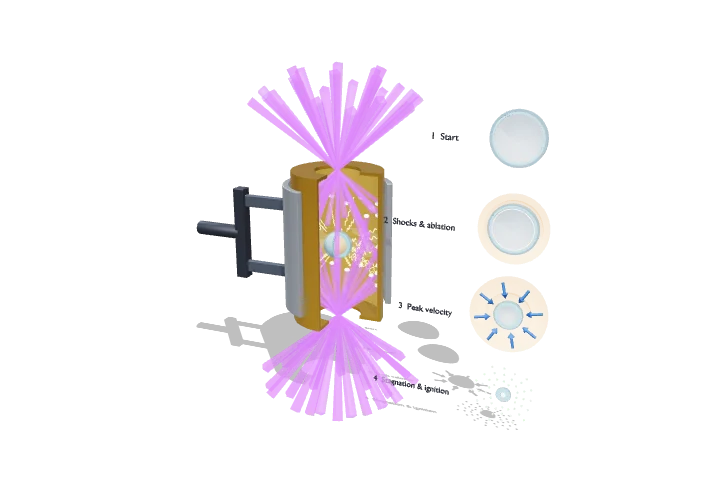 Open the interactive 3D model →
Can you make a tiny star in a lab by crushing a grain of fuel with lasers?
Inertial confinement fusion squeezes a frozen fuel bead smaller than a peppercorn so hard and so fast that its atoms fuse before it can fly apart. Lasers heat a little gold can, the can glows with X-rays, and the X-rays blast the bead’s surface off so the rest is pushed inward. In December 2022 one of these tiny implosions released more energy than the laser light that went in.
Inertial confinement fusion (ICF) compresses a tiny pellet of deuterium–tritium so fast and so hard that it fuses before it can fly apart, held together only by its own inertia. At the National Ignition Facility (NIF), 192 laser beams heat a gold hohlraum whose X-rays implode the capsule, and in December 2022 a target released more fusion energy than the laser light delivered to it.
Key facts
- Laser
- 192 beams, 351 nm, ≈ 2 MJ in ≈ 10 ns (peak ≈ 400–500 TW)
- Capsule
- ≈ 2 mm diameter; diamond ablator + ≈ 0.2 mg D–T ice
- Implosion velocity
- ≈ 380–400 km s⁻¹
- Convergence ratio
- ≈ 30 (initial capsule radius / hot-spot radius)
- Hot spot at stagnation
- ≈ 10 keV (≈ 120 million K), pressure of hundreds of Gbar
- 5 Dec 2022 result
- 2.05 MJ laser → 3.15 MJ fusion (target gain ≈ 1.5)
Parts you can explore (10)
- Hohlraum
- Cryogenic target holder
- Laser beams
- X-rays
- Ablator
- DT fuel layer
- Hot spot
- Fill tube
- Capsule support tent
- Implosion stages
In the 3D model
Rotate and take apart the model, follow a guided tour of what each part does and why it’s needed, change it with a live slider, and test yourself with a short quiz. Free, no sign-up.
Open Inertial confinement fusion in 3D →
OpenArc Models’ models are simplified teaching schematics. Terms · Privacy