Electromagnetism & electronics
Induction hob
Electromagnetism · Eddy-current heating
 Open the interactive 3D model →
How can a hob boil water in a pan while the glass under it stays cool enough to touch?
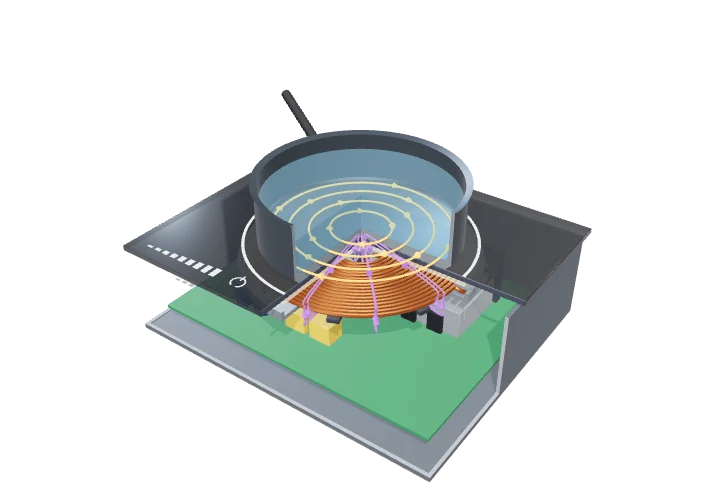
Under the glass of an induction hob is a flat coil of copper wire carrying a current that flips direction tens of thousands of times a second. That makes a rapidly changing magnetic field, which drives swirling electric currents inside the bottom of a steel pan. Those currents heat the pan itself — the hob never gets hot on its own.
An induction hob drives a flat copper coil with alternating current at tens of kilohertz, and the resulting changing magnetic field induces eddy currents in the base of a ferromagnetic pan. Those currents dissipate their energy by Joule heating in the pan itself, so heat is produced exactly where the food is and the glass stays comparatively cool.
Key facts
- Coil frequency
- ≈ 20–50 kHz (some designs up to ≈ 100 kHz)
- Zone power
- ≈ 1.2–2.3 kW; boost settings ≈ 3–3.7 kW
- Energy transfer to pan
- ≈ 80–90 %
- Skin depth in steel at 25 kHz
- ≈ 0.1 mm
- Glass-ceramic top
- ≈ 4 mm thick, non-conducting
- Coil inductance
- ≈ tens of µH, tuned with ≈ 0.3–1 µF
Parts you can explore (12)
- Ceramic glass top
- Touch controls
- Induction coil
- Ferrite bars
- Coil carrier
- Temperature sensor
- Driver electronics
- Heat sink and fan
- Housing
- Ferromagnetic pan
- Eddy currents
- Magnetic field
In the 3D model
Rotate and take apart the model, follow a guided tour of what each part does and why it’s needed, change it with a live slider, and test yourself with a short quiz. Free, no sign-up.
OpenArc Models’ models are simplified teaching schematics. Terms · Privacy