Physics
Inclined plane and friction
Mechanics · Forces and free-body diagrams
 Open the interactive 3D model →
Why does a book on a tilted table stay put — until, suddenly, it slides?
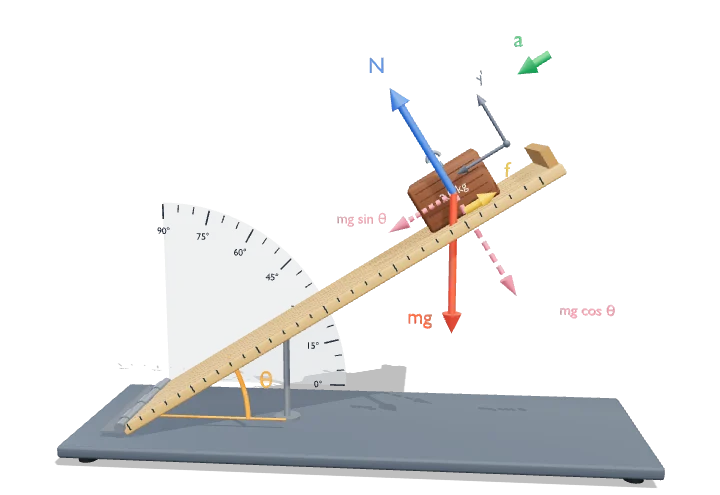
When you tilt a board, gravity pulls a block on it partly down the slope. Friction between the block and the board pushes back just as hard, so the block stays still. But friction has a limit: tilt the board past a certain angle and the block breaks free and slides faster and faster.
A block on a ramp is acted on by only three forces — its weight, the normal force and friction — and resolving the weight along and perpendicular to the slope turns the problem into two one-dimensional ones. Static friction holds the block until tan θ exceeds μs; after that it slides with acceleration g(sin θ − μk cos θ).
Key facts
- Weight components
- mg sin θ along the slope, mg cos θ into it
- Normal force
- N = mg cos θ (no motion perpendicular to the surface)
- Slipping condition
- tan θ > μs, independent of mass
- Model block
- 2.0 kg, wood on wood: μs = 0.50, μk = 0.30
- Critical angle (model)
- θc = arctan 0.50 = 26.6°
- Acceleration at 32° (model)
- a = 9.81(0.530 − 0.30 × 0.848) ≈ 2.7 m/s²
Parts you can explore (11)
- Inclined board
- Base and hinge
- Block
- Weight mg
- Normal force N
- Friction f
- Weight components
- Acceleration a
- Angle arc θ
- Protractor scale
- Tilted axes
In the 3D model
Rotate and take apart the model, follow a guided tour of what each part does and why it’s needed, change it with a live slider, and test yourself with a short quiz. Free, no sign-up.
Open Inclined plane and friction in 3D →
OpenArc Models’ models are simplified teaching schematics. Terms · Privacy