Astronomy & space
Ice giants: Uranus and Neptune
Planetary science · Ice giants
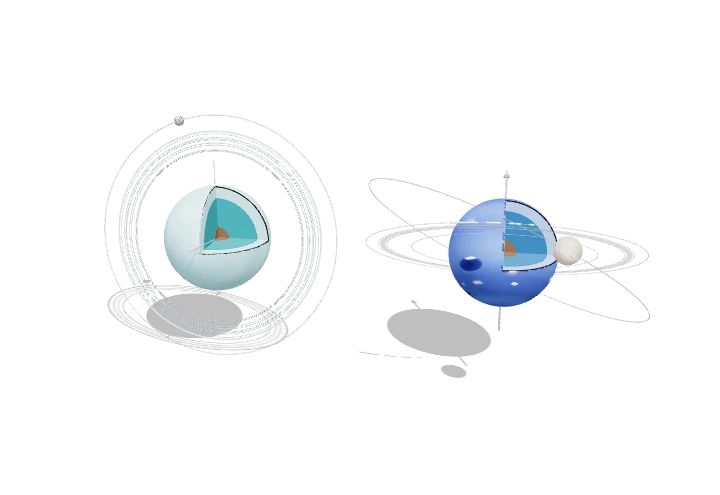 Open the interactive 3D model →
Why do two planets called “ice giants” turn out to be hot inside — and why does one of them roll around the Sun on its side?
Uranus and Neptune are the two most distant planets, each about four times wider than Earth. Unlike Jupiter and Saturn, which are mostly hydrogen gas, they are mostly made of water, ammonia and methane — called “ices” by scientists, though deep inside they are a hot, squashed fluid. Uranus is tipped right over on its side, and Neptune has the fastest winds of any planet.
Uranus and Neptune are ice giants: beneath thin hydrogen–helium envelopes, most of their mass is a hot, dense fluid of water, ammonia and methane around small rocky cores. Uranus spins on its side with dark narrow rings, while Neptune, despite weaker sunlight, has the fastest winds in the Solar System and a captured, retrograde moon, Triton.
Key facts
- Radius
- Uranus 25,559 km; Neptune 24,764 km (≈ 4 Earth radii)
- Mass
- Uranus 14.5 M⊕; Neptune 17.1 M⊕
- Mean density
- Uranus 1.27 g/cm³; Neptune 1.64 g/cm³
- Obliquity
- Uranus 97.8°; Neptune 28.3°
- Rotation period
- Uranus 17.2 h; Neptune 16.1 h
- Distance from Sun
- Uranus 19.2 AU; Neptune 30.1 AU
Parts you can explore (12)
- Uranus
- Neptune
- Great Dark Spot
- Hydrogen–helium envelope
- Icy mantle
- Rocky core
- Uranian rings
- Neptunian rings
- Miranda
- Triton
- Moon orbits
- Spin axes
In the 3D model
Rotate and take apart the model, follow a guided tour of what each part does and why it’s needed, change it with a live slider, and test yourself with a short quiz. Free, no sign-up.
Open Ice giants: Uranus and Neptune in 3D →
OpenArc Models’ models are simplified teaching schematics. Terms · Privacy