Physics
Hydrogen spectrum
Atomic physics · Bohr model and line spectra
 Open the interactive 3D model →
Why does glowing hydrogen give off just a few sharp colours instead of a whole rainbow?
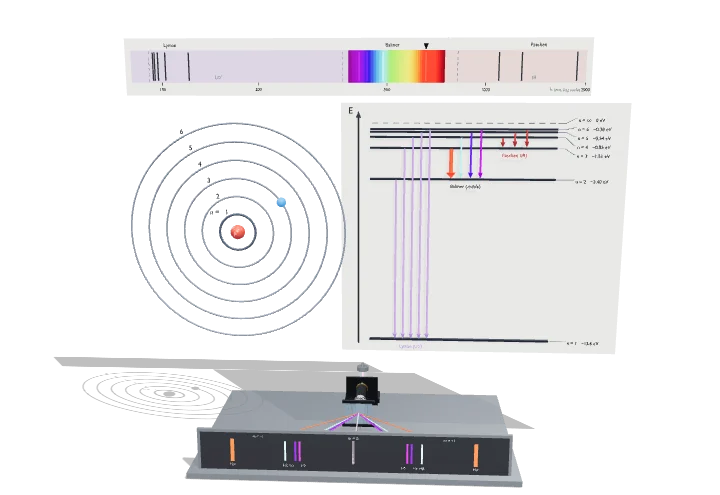
A hydrogen atom is one electron held by one proton, and the electron is only allowed to have certain fixed amounts of energy. When it drops from a higher level to a lower one, it gives out a tiny packet of light (a photon) whose colour depends on the size of the drop. Only a few drop sizes are possible, so only a few colours appear.
Excited hydrogen atoms emit light only at sharp, discrete wavelengths because the electron can occupy only certain energy levels, E_n = −13.6 eV/n², and each photon carries away exactly the difference between two levels. The Rydberg formula 1/λ = R_H(1/n_f² − 1/n_i²) predicts every line, grouping them into the ultraviolet Lyman, visible Balmer and infrared Paschen series.
Key facts
- Ground-state energy
- −13.6 eV (ionisation energy 13.6 eV)
- Energy levels
- E_n = −13.6 eV / n²
- Rydberg constant for hydrogen
- R_H = 1.09678 × 10⁷ m⁻¹
- Visible Balmer lines
- 656, 486, 434, 410 nm (vacuum)
- Bohr radius
- a₀ = 0.0529 nm; r_n = n²a₀
- Model scale
- Orbit radii drawn ∝ n, not n²; energy ladder to scale
Parts you can explore (12)
- Nucleus (proton)
- Electron
- Bohr orbits
- Energy-level ladder
- Lyman series
- Balmer series
- Paschen series
- Emitted photon
- Hydrogen discharge tube
- Grating spectrometer
- Spectrum screen
- Spectral series chart
In the 3D model
Rotate and take apart the model, follow a guided tour of what each part does and why it’s needed, change it with a live slider, and test yourself with a short quiz. Free, no sign-up.
Open Hydrogen spectrum in 3D →
OpenArc Models’ models are simplified teaching schematics. Terms · Privacy