Chemistry
Hydrogen fuel cell (PEM)
Electrochemistry · Energy conversion
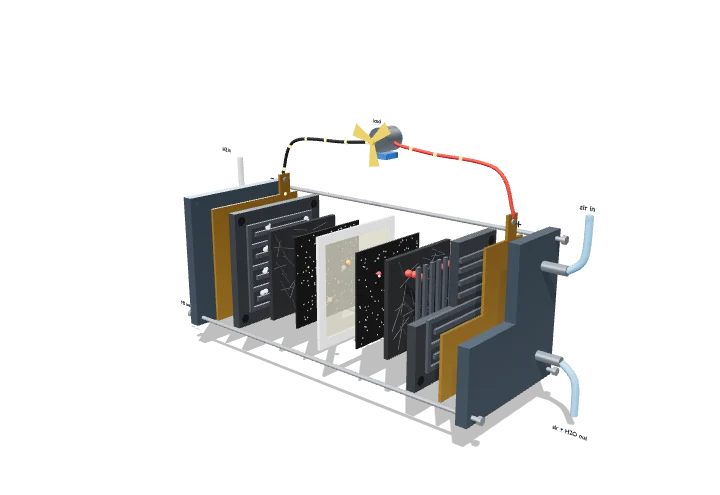 Open the interactive 3D model →
Can you make electricity from hydrogen without burning it — with water as the only exhaust?
A fuel cell feeds hydrogen to one side of a thin plastic sheet and air to the other. Platinum splits each hydrogen molecule into protons, which pass through the sheet, and electrons, which cannot — so the electrons travel round a wire and power a motor. On the far side everything meets oxygen and becomes water.
A proton-exchange-membrane fuel cell converts the chemical energy of hydrogen and oxygen directly into electricity, with water and heat as the only products. Hydrogen is oxidised at a platinum anode, protons cross a polymer membrane, electrons flow through the external load, and oxygen is reduced to water at the cathode.
Key facts
- Overall reaction
- H₂ + ½O₂ → H₂O
- Reversible voltage (25 °C, liquid water)
- 1.23 V
- Typical open-circuit voltage
- ≈ 0.95–1.0 V
- Typical operating voltage
- ≈ 0.6–0.7 V per cell
- Operating temperature
- ≈ 60–80 °C
- Membrane thickness
- ≈ 15–50 µm
Parts you can explore (12)
- End plates
- Current collectors
- Bipolar plates
- Gas diffusion layers
- Catalyst layers (Pt/C)
- Nafion membrane
- Gas ports
- External circuit and load
- Hydrogen molecules
- Protons (H⁺)
- Electrons
- Oxygen and water
In the 3D model
Rotate and take apart the model, follow a guided tour of what each part does and why it’s needed, change it with a live slider, and test yourself with a short quiz. Free, no sign-up.
Open Hydrogen fuel cell (PEM) in 3D →
OpenArc Models’ models are simplified teaching schematics. Terms · Privacy