Power & energy
PEM hydrogen electrolyser
Electrochemistry · Hydrogen
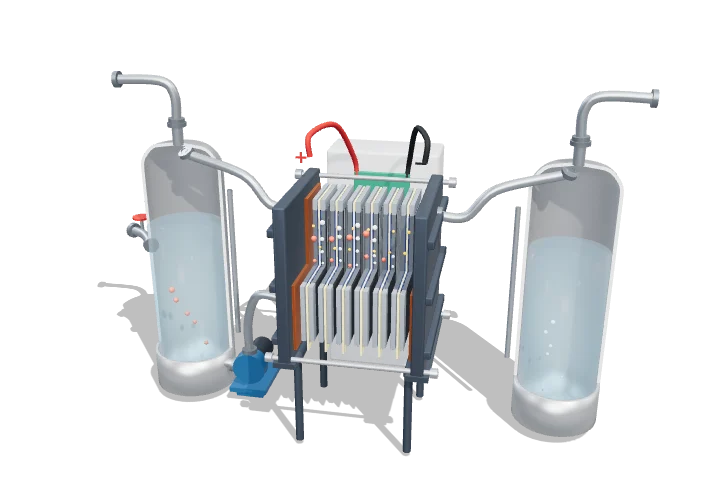 Open the interactive 3D model →
Can you turn water into a fuel using nothing but electricity?
An electrolyser pushes electricity through water and splits it into its two ingredients: hydrogen gas and oxygen gas. Inside, a thin plastic sheet lets only tiny charged bits of hydrogen (protons) pass, keeping the two gases apart. The hydrogen can later be burned or used in a fuel cell, giving back much of the energy that went in.
A proton-exchange-membrane (PEM) electrolyser uses direct current to split water into hydrogen at the cathode and oxygen at the anode, with protons crossing a thin acidic polymer membrane between them. Hydrogen output is fixed by the current through Faraday’s law, while the cell voltage, and therefore the electricity used per kilogram, rises with current density.
Key facts
- Reversible cell voltage
- 1.23 V at 25 °C
- Thermoneutral voltage
- 1.48 V (HHV basis)
- Operating cell voltage
- ≈ 1.7–2.1 V at 1–3 A cm⁻²
- Operating temperature
- ≈ 50–80 °C
- Electricity per kg H₂
- ≈ 50–55 kWh (system); minimum 39.4 kWh (HHV)
- Water consumed
- ≈ 9 kg per kg H₂ (stoichiometric)
Parts you can explore (13)
- End plates and tie rods
- Current collectors
- Bipolar plates (titanium)
- Porous transport layers
- Catalyst layers (IrO₂ / Pt)
- Proton-exchange membrane
- Oxygen gas separator
- Hydrogen gas separator
- Water supply and circulation
- DC power supply
- Oxygen bubbles
- Hydrogen bubbles
- Protons (H⁺)
In the 3D model
Rotate and take apart the model, follow a guided tour of what each part does and why it’s needed, change it with a live slider, and test yourself with a short quiz. Free, no sign-up.
Open PEM hydrogen electrolyser in 3D →
OpenArc Models’ models are simplified teaching schematics. Terms · Privacy