Power & energy
Hydroelectric dam
Renewable energy · Hydropower
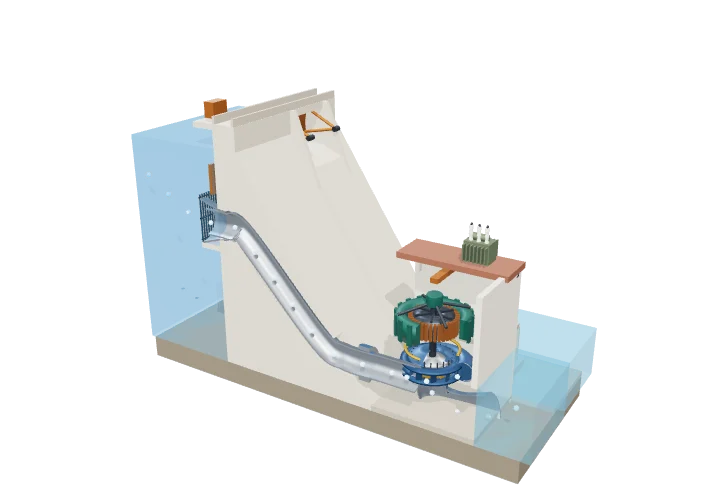 Open the interactive 3D model →
How does water falling behind a dam end up lighting a whole city?
A dam holds back a river to make a deep lake. Water from low down in the lake rushes down a big pipe and spins a turbine, a wheel with curved blades, which turns a generator to make electricity. The further the water falls and the more of it flows, the more power you get.
A hydroelectric dam converts the gravitational potential energy of stored water into electricity: water falling through the head H is turned into pressure and velocity, and a turbine converts it into shaft work that drives a generator. The power available is P = ρgQHη, so large plants combine high head, large flow and turbine–generator efficiencies near 90%.
Key facts
- Power equation
- P = ρgQHη
- Energy per cubic metre per 100 m of head
- ≈ 0.98 MJ ≈ 0.27 kWh
- Francis turbine heads
- ≈ 40–600 m (most common turbine type)
- Overall plant efficiency
- ≈ 85–92%
- Share of world electricity
- ≈ 15% (largest renewable source)
- Largest plant
- Three Gorges, China: 22.5 GW
Parts you can explore (14)
- Dam
- Reservoir
- Intake and trash rack
- Penstock
- Scroll case
- Wicket gates
- Francis runner
- Generator
- Draft tube
- Powerhouse
- Transformer
- Tailrace
- Spillway
- Water flow
In the 3D model
Rotate and take apart the model, follow a guided tour of what each part does and why it’s needed, change it with a live slider, and test yourself with a short quiz. Free, no sign-up.
Open Hydroelectric dam in 3D →
OpenArc Models’ models are simplified teaching schematics. Terms · Privacy