Earth & space
Hurricane
Earth science · Meteorology
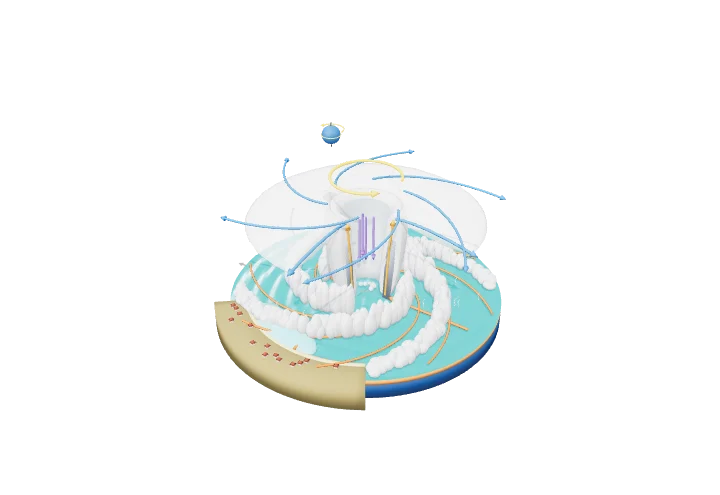 Open the interactive 3D model →
How does warm seawater power winds strong enough to rip roofs off houses?
A hurricane is a giant spinning storm that feeds on warm ocean water. Warm, wet air spirals in towards the centre, rises in a ring of towering clouds and turns its water vapour into rain, releasing a huge amount of heat. That heat keeps the air rising and the winds blowing, as long as the storm stays over warm sea.
A hurricane is a warm-core low-pressure system that extracts heat from a warm ocean and converts it into wind, behaving like a heat engine running between the sea surface and the cold upper troposphere. Air spirals inward near the surface, rises in the eyewall, flows out at the top, and sinks in the calm eye.
Key facts
- Minimum sea-surface temperature
- ≈ 26.5 °C through ~50 m of ocean
- Hurricane threshold
- sustained 1-min wind ≥ 64 kt (119 km/h, 74 mph)
- Typical eye diameter
- 20–65 km
- Radius of gale-force winds
- ≈ 100–500 km
- Lowest observed central pressure
- 870 hPa (Typhoon Tip, 1979)
- Formation latitude
- usually 5–25° from the equator
Parts you can explore (9)
- Warm ocean surface
- Surface inflow
- Eyewall
- Eye
- Cirrus canopy
- Outflow aloft
- Spiral rainbands
- Storm surge
- Coriolis rotation
In the 3D model
Rotate and take apart the model, follow a guided tour of what each part does and why it’s needed, change it with a live slider, and test yourself with a short quiz. Free, no sign-up.
OpenArc Models’ models are simplified teaching schematics. Terms · Privacy