Human body
Human skeleton
Anatomy · Skeletal system
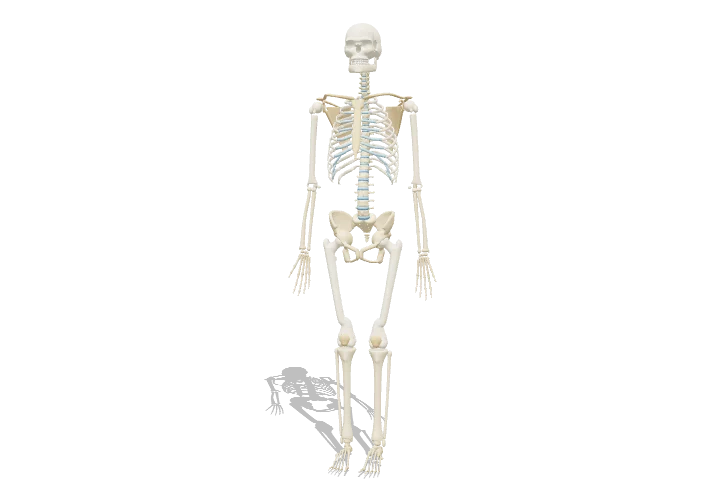 Open the interactive 3D model →
Why are you born with about 270 bones but end up with only about 206?
Your skeleton is the frame that holds you up, protects soft organs like your brain and heart, and gives your muscles something to pull on. Babies have more bones because many small pieces slowly join together as they grow. Bones are alive: they repair themselves, store calcium and make blood cells inside.
The adult human skeleton has about 206 bones, divided into the axial skeleton (skull, vertebral column, ribs and sternum) and the appendicular skeleton (pectoral and pelvic girdles and the limbs). It supports and protects the body, provides levers for muscles, stores minerals and houses the marrow that makes blood cells.
Key facts
- Adult bones
- ≈ 206 (80 axial, 126 appendicular); ≈ 270 at birth
- Skeletal mass
- ≈ 12–15% of body mass
- Longest bone
- Femur, ≈ 26–27% of stature
- Hand and foot bones
- 27 per hand, 26 per foot — over half of all bones
- Bone turnover
- ≈ 10% of the adult skeleton remodelled per year
- Calcium stored
- ≈ 99% of the body’s calcium (≈ 1 kg)
Parts you can explore (13)
- Skull
- Vertebral column
- Rib cage
- Sternum
- Pectoral girdle
- Humerus
- Radius and ulna
- Hand
- Pelvic girdle
- Femur
- Patella
- Tibia and fibula
- Foot
In the 3D model
Rotate and take apart the model, follow a guided tour of what each part does and why it’s needed, change it with a live slider, and test yourself with a short quiz. Free, no sign-up.
OpenArc Models’ models are simplified teaching schematics. Terms · Privacy