Human body
Human heart
Anatomy · Cardiovascular system
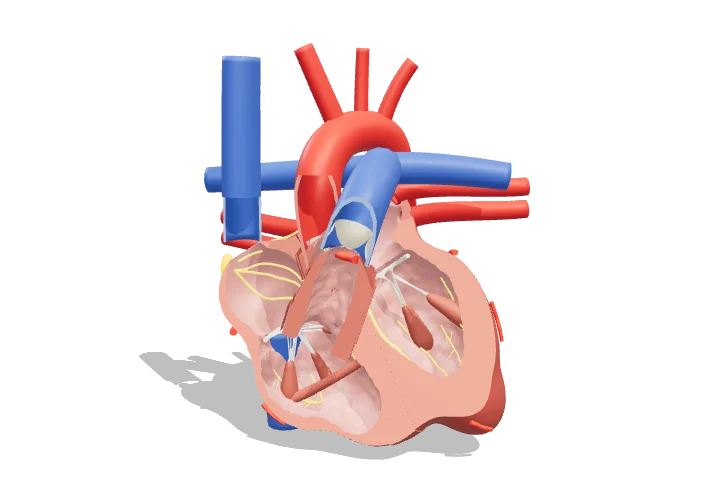 Open the interactive 3D model →
How does a fist-sized muscle pump about 7,000 litres of blood a day without ever taking a break?
Your heart is really two pumps side by side. The right side sends blood to the lungs to pick up oxygen, and the left side sends that oxygen-rich blood all around your body. One-way valves make sure the blood only ever flows forwards, and a built-in electrical spark sets the beat.
The heart is two muscular pumps in series: the right side drives blood through the low-pressure pulmonary circuit and the left side through the high-pressure systemic circuit. Four passive valves, opened and closed by pressure differences, and a specialised conduction system turn rhythmic contraction into one-way flow.
Key facts
- Mass (adult)
- ≈ 250–350 g
- Resting cardiac output
- ≈ 5 L/min (≈ 70 mL × 70 beats/min)
- LV / RV systolic pressure
- ≈ 120 / ≈ 25 mmHg
- LV / RV free-wall thickness
- ≈ 10–12 mm / ≈ 3–5 mm
- End-diastolic / end-systolic volume (LV)
- ≈ 120 / ≈ 50 mL; ejection fraction 55–70%
- Beats per day
- ≈ 100,000
Parts you can explore (16)
- Right atrium
- Left atrium
- Right ventricle
- Left ventricle
- Interventricular septum
- Tricuspid valve
- Mitral valve
- Pulmonary valve
- Aortic valve
- Chordae tendineae & papillary muscles
- Aorta
- Pulmonary trunk & arteries
- Venae cavae
- Pulmonary veins
- Coronary arteries
- Conduction system
In the 3D model
Rotate and take apart the model, follow a guided tour of what each part does and why it’s needed, change it with a live slider, and test yourself with a short quiz. Free, no sign-up.
OpenArc Models’ models are simplified teaching schematics. Terms · Privacy