Human body
Human eye
Anatomy · Special senses
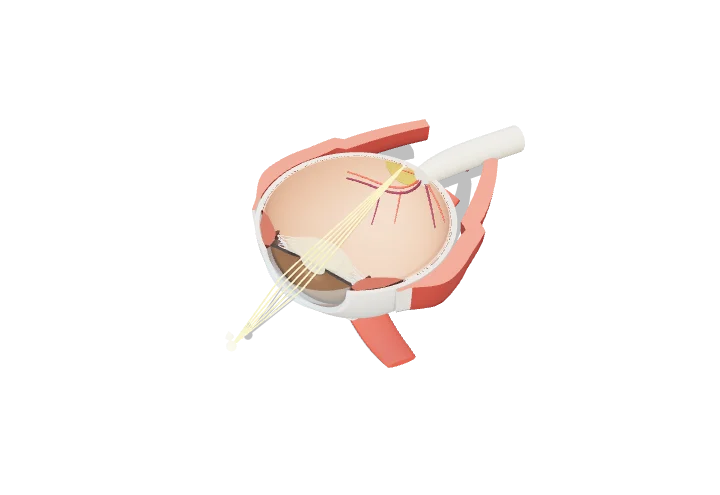 Open the interactive 3D model →
How can your eye snap from a distant mountain to the words on your phone in a fraction of a second?
Your eye works like a camera: the clear front window (the cornea) and a soft lens bend light so it forms a tiny, upside-down picture on the retina at the back. The retina turns that light into nerve signals and the optic nerve carries them to the brain. When you look at something close, a ring of muscle lets the lens bulge so the picture stays sharp.
The eye is a fluid-filled optical instrument whose cornea and lens form a sharp, inverted image on the retina, about 24 mm behind the front surface. The cornea provides most of the roughly 60 dioptres of focusing power, while the lens fine-tunes it — accommodation — so that both distant and near objects can be focused on the fovea.
Key facts
- Axial length (adult)
- ≈ 24 mm
- Total refractive power
- ≈ 60 D (cornea ≈ 43 D, relaxed lens ≈ 20 D)
- Amplitude of accommodation
- ≈ 10–12 D at age 10–20; ≈ 1 D by age 60
- Pupil diameter
- ≈ 2–8 mm
- Photoreceptors
- ≈ 120 million rods, ≈ 6 million cones
- Optic-nerve axons
- ≈ 1.2 million
Parts you can explore (15)
- Cornea
- Aqueous humour
- Iris & pupil
- Lens
- Suspensory ligaments (zonules)
- Ciliary body
- Vitreous humour
- Retina
- Macula & fovea
- Optic disc
- Optic nerve
- Choroid
- Sclera
- Extraocular muscles
- Light rays
In the 3D model
Rotate and take apart the model, follow a guided tour of what each part does and why it’s needed, change it with a live slider, and test yourself with a short quiz. Free, no sign-up.
OpenArc Models’ models are simplified teaching schematics. Terms · Privacy